Judith Beheading Holofernes
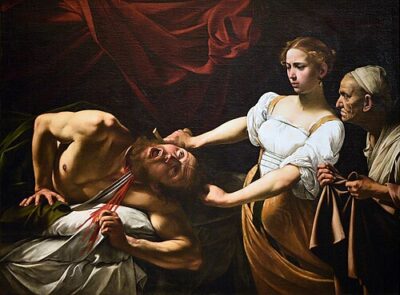
Judith Beheading Holofernes is a painting by Caravaggio. It came out in 1599. It is based on Book of Judith.
- Came out
- 1599
- Created by
- Caravaggio
- Genre
- religious art
All 6 facts, and where they come from
Facts
6 facts · 0 confirmed by two sources · 2 cited · 4 from one source
Where this comes from
Papalocal keeps its own record. It started from these sources; what each one said is kept here as it was copied, so a change on their side never changes this page by itself. Tap one to read its version.
What Wikidata says · copied November 17, 2026 · revision 2541096811
- Described as
- painting by Caravaggio
- What it is
- painting
- Created by
- Caravaggio · 1 reference
- Genre
- religious art
- Based on
- Book of Judith
- Came out
- 1599 · 1 reference
- Country
- Italy · 1 reference
- Wikipedias with a page
- 29
Wikidata item Q2470123 (wikidata.org/wiki/Q2470123), public domain (CC0). Copied 2026-11-17.
What Wikipedia says · copied November 17, 2026 · revision 1371602996
Judith Beheading Holofernes is a painting of the biblical episode by the Italian Baroque artist Caravaggio, painted in c. 1599 – 1600 or 1602, in which the widow Judith stayed with the Assyrian general Holofernes in his tent after a banquet then decapitated him after he passed out drunk. The painting was rediscovered in 1950 and is part of the collection of the Galleria Nazionale d'Arte Antica in Rome. The exhibition 'Dentro Caravaggio', Royal Palace of Milan (Sept 2017 – Jan 2018), suggests a date of 1602 on account of the use of light underlying sketches not seen in Caravaggio's early work but characteristic of his later works. The exhibition catalogue (Skira, 2018, p88) also cites biographer artist Giovanni Pietro Baglione's account that the work was commissioned by Genoese banker Ottavio Costa.
A second painting on the same subject (see below) and dated to 1607, attributed by several experts to Caravaggio but still disputed by others, was rediscovered by chance in 2014 and went on sale in June 2019 as Judith and Holofernes.
From the Wikipedia article “Judith Beheading Holofernes (Caravaggio)” (en.wikipedia.org/wiki/Judith_Beheading_Holofernes_(Caravaggio)), by its contributors, under CC BY-SA 4.0 (creativecommons.org/licenses/by-sa/4.0/). Copied 2026-11-17; not changed.
Confirmed Two sources agree. Cited One source, and it names where it got it. One source One source, without a reference of its own. Sources disagree The sources disagree. We show the best-supported value and keep theirs below.
Picture: Caravaggio, via Wikimedia Commons · CC BY-SA 4.0