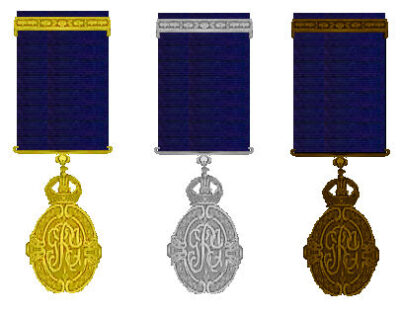
Kaisar-i-Hind Medal
Kaisar-i-Hind Medal is a civilian award of the British Raj. It was created in 1900.
- Country
- India
- Created
- April 10, 1900
All 3 facts, and where they come from
Facts
3 facts · 0 confirmed by two sources · 0 cited · 3 from one source
Where this comes from
Papalocal keeps its own record. It started from these sources; what each one said is kept here as it was copied, so a change on their side never changes this page by itself. Tap one to read its version.
What Wikidata says · copied November 17, 2026 · revision 2454487255
- Described as
- civilian award of the British Raj
- What it is
- award
- Created
- April 10, 1900 · 1 reference
- Country
- India
- Wikipedias with a page
- 13
Wikidata item Q2423226 (wikidata.org/wiki/Q2423226), public domain (CC0). Copied 2026-11-17.
What Wikipedia says · copied November 17, 2026 · revision 1386190418
The Kaisar-i-Hind Medal for Public Service in India was a medal awarded by the Emperor/Empress of India between 1900 and 1947, to "any person without distinction of race, occupation, position, or sex ... who shall have distinguished himself (or herself) by important and useful service in the advancement of the public interest in India."
The name "Kaisar-i-Hind" (Urdu: قیصرِ ہند qaisar-e-hind) literally means "Emperor of India" in the Urdu language. The word kaisar, meaning "emperor" is a derivative of the Roman imperial title Caesar, via Persian (see Qaysar-i Rum) from Greek Καίσαρ Kaísar, and is cognate with the German title Kaiser, which was borrowed from Latin at an earlier date. Based upon this, the title Kaisar-i-Hind was coined in 1876 by the orientalist G.W. Leitner as the official imperial title for the British monarch in India. The last ruler to bear it was George VI.
Kaisar-i-Hind was also inscribed on the obverse side of the India General Service Medal (1909), as well as on the Indian Meritorious Service Medal.
From the Wikipedia article “Kaisar-i-Hind Medal” (en.wikipedia.org/wiki/Kaisar-i-Hind_Medal), by its contributors, under CC BY-SA 4.0 (creativecommons.org/licenses/by-sa/4.0/). Copied 2026-11-17; not changed.
Confirmed Two sources agree. Cited One source, and it names where it got it. One source One source, without a reference of its own. Sources disagree The sources disagree. We show the best-supported value and keep theirs below.
Picture: Robert Prummel, via Wikimedia Commons · CC BY-SA 3.0