
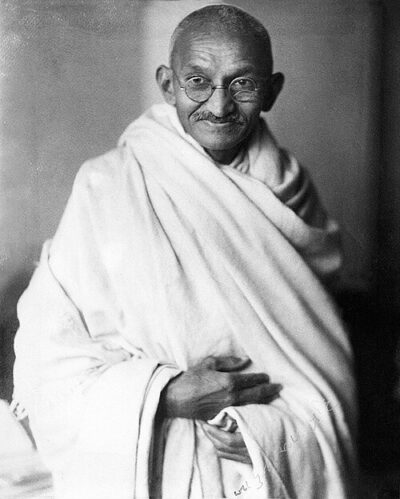
Mahatma Gandhi
Mahatma Gandhi was an Indian independence activist. Born October 2, 1869, in Porbandar. Died January 30, 1948, in Gandhi Smriti. Known for satyagraha. Educated at Mahatma Gandhi Museum and Inner Temple. Awards include Time Person of the Year, Order of the Companions of O. R. Tambo and Queen's South Africa Medal.
Facts
52 facts · 2 confirmed by two sources · 19 cited · 31 from one source
Where this comes from
Papalocal keeps its own record. It started from these sources; what each one said is kept here as it was copied, so a change on their side never changes this page by itself. Tap one to read its version.
What Wikidata says · copied November 16, 2026 · revision 2567490707
- Described as
- Indian independence activist (1869–1948)
- Other names
- Mohandas K. Gandhi, M. K. Gandhi, Mohandas K Gandhi, Gandhiji, M K Gandhi, Bapuji, MK Gandhi, Father of the Nation, Mahatma Mohandas Karamchand Gandhi, Gandhi, Bapu, Mohandas Karamchand Gandhi
- Born
- October 2, 1869 · 19 references
- Died
- January 30, 1948 · 17 references
- Born in
- Porbandar · 4 references
- Died in
- Gandhi Smriti · 2 references
- Buried in
- Raj Ghat and associated memorials
- Cause of death
- gunshot wound · 1 reference
- Name at birth
- મોહનદાસ ગાંધી
- Citizen of
- British Raj (–1947) · 1 reference; Dominion of India (1947–) · 1 reference; India (1947–)
- Occupation
- politician · 4 references; barrister · 2 references; political writer · 1 reference; journalist · 1 reference; philosopher · 2 references; autobiographer · 1 reference; essayist · 1 reference; newspaper editor · 1 reference
- Political party
- Indian National Congress · 1 reference; Natal Indian Congress · 1 reference
- Education
- Mahatma Gandhi Museum (–1877); Inner Temple; University College London (1888–) · 1 reference; Samaldas Arts College
- Member of
- Inner Temple; Vegetarian Society
- Known for
- satyagraha · 1 reference
- Awards
- Time Person of the Year (1930); Order of the Companions of O. R. Tambo; Queen's South Africa Medal · 1 reference; Natal Native Rebellion Medal · 1 reference; Kaisar-i-Hind Medal · 1 reference
- Field
- philosophy; jurisprudence; pacifism
- Spouse
- Kasturba Gandhi (1883–1944) · 2 references
- Children
- Harilal Gandhi · 2 references; Manilal Gandhi · 2 references; Manilal gandhi · 1 reference; Devdas Gandhi · 1 reference
- Father
- Karamchand Uttamchand Gandhi · 2 references
- Mother
- Putlibai Karamchand Gandhi · 2 references
- Siblings
- Raliatbehn Gandhi · 1 reference; Muliben Gandhi · 1 reference; Pankunvarben Gandhi · 1 reference; Laxmidas Karamchand Gandhi · 1 reference; Karsandas Gandhi · 1 reference
- Religion
- Hinduism · 1 reference
- Lived in
- London (1888–1891) · 1 reference; India (1891–1893) · 1 reference; South Africa (1893–1915) · 1 reference
- Height
- 1.64 m (5 ft 5 in)
- Wikipedias with a page
- 287
Wikidata item Q1001 (wikidata.org/wiki/Q1001), public domain (CC0). Copied November 16, 2026.
What Wikipedia says · copied November 16, 2026 · revision 1385697121
Mohandas Karamchand Gandhi (2 October 1869 – 30 January 1948) was an Indian lawyer, anti-colonial nationalist, and political ethicist who employed nonviolent resistance to lead the successful campaign for India's independence from British rule, and whose legacy would later inspire movements for civil rights and freedom across the world. The honorific Mahātmā (Sanskrit: "great-souled", "venerable"), first applied to him in 1914 in South Africa, is now used throughout the world.
Born and raised in a Hindu family in coastal Gujarat, Gandhi was trained in the law at the Inner Temple in London and was called to the bar at the age of 22. After two uncertain years in India, where he was unable to start a successful law practice, Gandhi moved to South Africa in 1893 to represent an Indian merchant in a lawsuit. He went on to live in South Africa for the next 21 years. Here, Gandhi raised a family and first employed nonviolent resistance in a campaign for civil rights. In 1915, aged 45, he returned to India and soon set about organising peasants, farmers, and urban labourers to protest against discrimination and excessive land tax.
Assuming leadership of the Indian National Congress in 1921, Gandhi led nationwide campaigns for easing poverty, expanding women's rights, building religious and ethnic amity, ending untouchability, and, above all, achieving swaraj or self-rule. Gandhi adopted the short dhoti woven with hand-spun yarn as a mark of identification with India's rural poor. He began to live in a self-sufficient residential community, to eat simple food, and undertake long fasts as a means of both introspection and political protest. Bringing anti-colonial nationalism to the common Indians, Gandhi led them in challenging the British-imposed salt tax with the 400 km (250 mi) Dandi Salt March in 1930 and in calling for the British to quit India in 1942. He was imprisoned many times and for many years in both South Africa and India.
Gandhi's vision of an independent India based on religious pluralism was challenged in the early 1940s by a Muslim nationalism which demanded a separate homeland for Muslims within British India. In August 1947, Britain granted independence, but the British Indian Empire was partitioned into two dominions, a Hindu-majority India and a Muslim-majority Pakistan. As many displaced Hindus, Muslims, and Sikhs made their way to their new lands, religious violence broke out, especially in Punjab and Bengal. Abstaining from the official celebration of independence, Gandhi visited the affected areas, attempting to alleviate distress. In the months following, he undertook several hunger strikes to stop the religious violence. The last of these was begun in Delhi on 12 January 1948, when Gandhi was 78. There developed a Hindu nationalist opposition to Gandhi's advocacy of nonviolence, as well as his friendship with Indian Muslims. Among these was Nathuram Godse, a militant Hindu nationalist from Pune, western India, who assassinated Gandhi by firing three bullets into his chest at an interfaith prayer meeting in Delhi on 30 January 1948.
Gandhi's birthday, 2 October, is commemorated in India as Gandhi Jayanti, a national holiday, and worldwide as the International Day of Nonviolence. Gandhi is considered to be the Father of the Nation in post-colonial India. During India's nationalist movement and in several decades immediately after, he was also commonly called Bapu, an endearment roughly meaning "father".
- Born, in its opening lines
- October 2, 1869
- Died, in its opening lines
- January 30, 1948
From the Wikipedia article “Mahatma Gandhi” (en.wikipedia.org/wiki/Mahatma_Gandhi), by its contributors, under CC BY-SA 4.0 (creativecommons.org/licenses/by-sa/4.0/). Copied November 16, 2026; not changed.
Confirmed Two sources agree. Cited One source, and it names where it got it. One source One source, without a reference of its own. Sources disagree The sources disagree. We show the best-supported value and keep theirs below.
