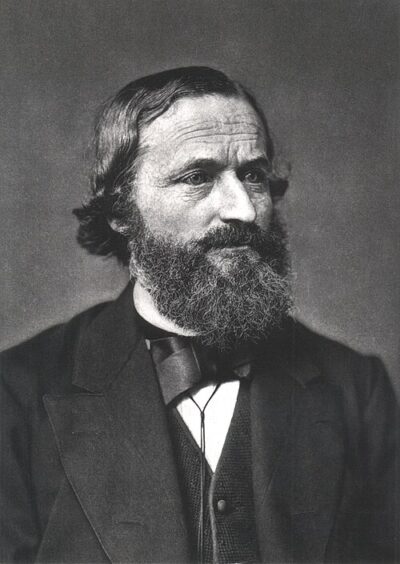
Kirchhoff's circuit laws
Kirchhoff's circuit laws is a relations between currents and voltages on sections of any electrical circuit.
All 2 facts, and where they come from
Facts
2 facts · 0 confirmed by two sources · 0 cited · 2 from one source
Where this comes from
Papalocal keeps its own record. It started from these sources; what each one said is kept here as it was copied, so a change on their side never changes this page by itself. Tap one to read its version.
What Wikidata says · copied November 17, 2026 · revision 2532457851
- Described as
- relations between currents and voltages on sections of any electrical circuit
- Other names
- Kirchhoff's laws, Kirchhoff circuit laws, KCL versions
- What it is
- physical law
- Named after
- Gustav Kirchhoff
- Wikipedias with a page
- 70
Wikidata item Q187672 (wikidata.org/wiki/Q187672), public domain (CC0). Copied 2026-11-17.
What Wikipedia says · copied November 17, 2026 · revision 1386068490
Kirchhoff's circuit laws are two equalities that deal with the current and potential difference (commonly known as voltage) in the lumped element model of electrical circuits. They were first described in 1845 by German physicist Gustav Kirchhoff. This generalized the work of Georg Ohm and preceded the work of James Clerk Maxwell. Widely used in electrical engineering, they are also called Kirchhoff's rules or simply Kirchhoff's laws. These laws can be applied in time and frequency domains and form the basis for network analysis.
Both of Kirchhoff's laws can be understood as corollaries of Maxwell's equations in the low-frequency limit. They are accurate for DC circuits, and for AC circuits at frequencies where the wavelengths of electromagnetic radiation are very large compared to the circuits.
From the Wikipedia article “Kirchhoff's circuit laws” (en.wikipedia.org/wiki/Kirchhoff's_circuit_laws), by its contributors, under CC BY-SA 4.0 (creativecommons.org/licenses/by-sa/4.0/). Copied 2026-11-17; not changed.
Confirmed Two sources agree. Cited One source, and it names where it got it. One source One source, without a reference of its own. Sources disagree The sources disagree. We show the best-supported value and keep theirs below.