
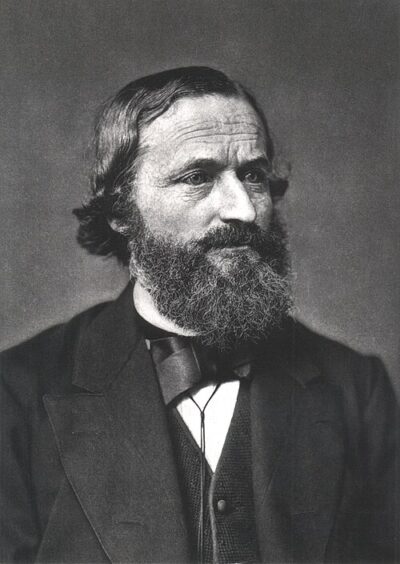
Gustav Kirchhoff
Gustav Kirchhoff was a German physicist. Born March 12, 1824, in Königsberg. Died October 17, 1887, in Berlin. Known for Kirchhoff's circuit laws, Kirchhoff's law of thermal radiation and Kirchhoff's theorem. Educated at University of Königsberg and Kneiphof Gymnasium. Awards include Pour le Mérite for Sciences and Arts order, Cothenius Medal and Rumford Medal.
Facts
46 facts · 2 confirmed by two sources · 20 cited · 24 from one source
Where this comes from
Papalocal keeps its own record. It started from these sources; what each one said is kept here as it was copied, so a change on their side never changes this page by itself. Tap one to read its version.
What Wikidata says · copied November 16, 2026 · revision 2568754344
- Described as
- German physicist (1824–1887)
- Other names
- Gustav Robert Kirchhoff
- Born
- March 12, 1824 · 11 references
- Died
- October 17, 1887 · 11 references
- Born in
- Königsberg · 5 references
- Died in
- Berlin · 5 references
- Buried in
- Alter St.-Matthäus-Kirchhof Berlin · 2 references
- Citizen of
- Kingdom of Prussia
- Occupation
- physicist · 1 reference; chemist; engineer; mathematician; university teacher · 1 reference
- Worked for
- Frederick William University Berlin (2 times) (1848–1887) · 1 reference; University of Wrocław (1850–1854); Heidelberg University (1855–1875) · 1 reference
- Education
- University of Königsberg (1842–1847) · 2 references; Kneiphof Gymnasium (–1842) · 1 reference
- Member of
- Royal Society of London (1875–); Hungarian Academy of Sciences; Royal Netherlands Academy of Arts and Sciences; American Academy of Arts and Sciences (1870–); Saint Petersburg Academy of Sciences (1862–); Royal Prussian Academy of Sciences; Göttingen Academy of Sciences and Humanities in Lower Saxony (1862–); National Academy of Sciences (1883–); Royal Society of Edinburgh (1868–); Academy of Sciences of Turin (1884–) · 1 reference
- Known for
- Kirchhoff's circuit laws; Kirchhoff's law of thermal radiation; Kirchhoff's theorem
- Awards
- Pour le Mérite for Sciences and Arts order; Cothenius Medal (1876); Rumford Medal (1862) · 1 reference; Matteucci Medal (1877) · 1 reference; Bavarian Maximilian Order for Science and Art (1877); Janssen Medal (1887); Davy Medal (1877) · 1 reference; Honorary Fellow of the Royal Society of Edinburgh (1868) · 1 reference; Foreign Member of the Royal Society (1875) · 2 references; honorary member of the Physics Association (Frankfurt am Main, Germany) (1860)
- Field
- physics; mechanics
- Spouse
- Clara Richelot (1857–1869) · 1 reference; Luise Brömmel (1872–1887) · 1 reference
- Father
- Friedrich Kirchhoff · 2 references
- Mother
- Juliane Kirchhoff · 1 reference
- Siblings
- Carl Kirchhoff · 1 reference
- Wikipedias with a page
- 94
Wikidata item Q60052 (wikidata.org/wiki/Q60052), public domain (CC0). Copied November 16, 2026.
What Wikipedia says · copied November 16, 2026 · revision 1380618249
Gustav Robert Kirchhoff (German: [ˈgʊstaːf ˈʁoːbɛʁt ˈkɪʁçhɔf]; 12 March 1824 – 17 October 1887) was a German physicist and mathematician who contributed to the fundamental understanding of electrical circuits, spectroscopy, and the emission of black-body radiation by heated objects. He coined the term black body in 1860.
Several different sets of concepts are named "Kirchhoff's laws" after him, which include Kirchhoff's circuit laws, Kirchhoff's law of thermal radiation, Kirchhoff's diffraction formula, and Kirchhoff's law of thermochemistry.
The Bunsen–Kirchhoff Award for spectroscopy is named after Kirchhoff and his colleague, Robert Bunsen.
- Born, in its opening lines
- March 12, 1824
- Died, in its opening lines
- October 17, 1887
From the Wikipedia article “Gustav Kirchhoff” (en.wikipedia.org/wiki/Gustav_Kirchhoff), by its contributors, under CC BY-SA 4.0 (creativecommons.org/licenses/by-sa/4.0/). Copied November 16, 2026; not changed.
Confirmed Two sources agree. Cited One source, and it names where it got it. One source One source, without a reference of its own. Sources disagree The sources disagree. We show the best-supported value and keep theirs below.
