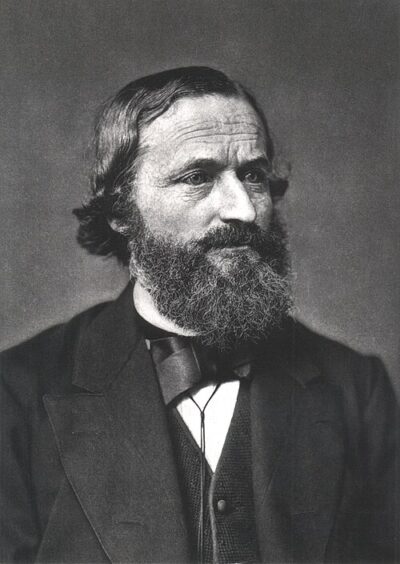
Kirchhoff's law of thermal radiation
Kirchhoff's law of thermal radiation is a law of wavelength-specific emission and absorption.
All 2 facts, and where they come from
Facts
2 facts · 0 confirmed by two sources · 0 cited · 2 from one source
Where this comes from
Papalocal keeps its own record. It started from these sources; what each one said is kept here as it was copied, so a change on their side never changes this page by itself. Tap one to read its version.
What Wikidata says · copied November 17, 2026 · revision 2559528986
- Described as
- law of wavelength-specific emission and absorption
- What it is
- physical law
- Named after
- Gustav Kirchhoff
- Wikipedias with a page
- 33
Wikidata item Q911035 (wikidata.org/wiki/Q911035), public domain (CC0). Copied 2026-11-17.
What Wikipedia says · copied November 17, 2026 · revision 1354904446
In heat transfer, Kirchhoff's law of thermal radiation refers to wavelength-specific radiative emission and absorption by a material body in thermodynamic equilibrium, including radiative exchange equilibrium. It is a special case of Onsager reciprocal relations as a consequence of the time reversibility of microscopic dynamics, also known as microscopic reversibility. It was stated by Gustav Kirchhoff in 1860.
A body at temperature T radiates electromagnetic energy. A perfect black body in thermodynamic equilibrium absorbs all light that strikes it, and radiates energy according to a unique law of radiative emissive power for temperature T (Stefan–Boltzmann law), universal for all perfect black bodies. For a material that is not a perfect black body, Kirchhoff's law states that:Here, the dimensionless coefficient of absorption (or the absorptivity) is the fraction of incident light (power) at each spectral frequency that is absorbed by the body when it is radiating and absorbing in thermodynamic equilibrium.
In slightly different terms, the emissive power of an arbitrary opaque body of fixed size and shape at a definite temperature can be described by a dimensionless ratio, sometimes called the emissivity: the ratio of the emissive power of the body to the emissive power of a black body of the same size and shape at the same fixed temperature. With this definition, Kirchhoff's law states, in simpler language:Kirchhoff's law has another corollary: the emissivity cannot exceed one (because the absorptivity cannot, by conservation of energy), so it is not possible to thermally radiate more energy than a black body, at equilibrium. In negative luminescence the angle and wavelength integrated absorption exceeds the material's emission; however, such systems are powered by an external source and are therefore not in thermodynamic equilibrium.
From the Wikipedia article “Kirchhoff's law of thermal radiation” (en.wikipedia.org/wiki/Kirchhoff's_law_of_thermal_radiation), by its contributors, under CC BY-SA 4.0 (creativecommons.org/licenses/by-sa/4.0/). Copied 2026-11-17; not changed.
Confirmed Two sources agree. Cited One source, and it names where it got it. One source One source, without a reference of its own. Sources disagree The sources disagree. We show the best-supported value and keep theirs below.