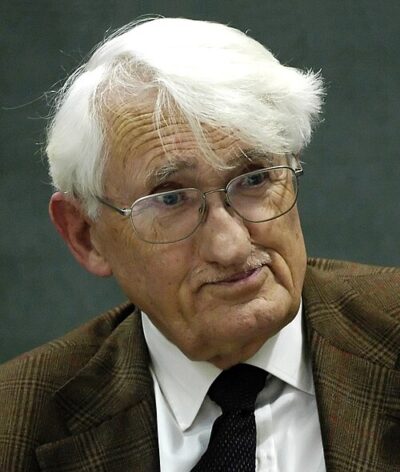
Knowledge and Human Interests
Knowledge and Human Interests is a non-fiction work by Jürgen Habermas. It came out in 1968.
- Published
- 1968
- Written by
- Jürgen Habermas
- Genre
- non-fiction literature
- Country of origin
- Germany
All 8 facts, and where they come from
Facts
8 facts · 0 confirmed by two sources · 2 cited · 6 from one source
Where this comes from
Papalocal keeps its own record. It started from these sources; what each one said is kept here as it was copied, so a change on their side never changes this page by itself. Tap one to read its version.
What Wikidata says · copied November 17, 2026 · revision 2565427311
- Described as
- non-fiction work by Jürgen Habermas
- Other names
- Erkenntnis und Interesse
- What it is
- philosophical work; literary work
- Written by
- Jürgen Habermas
- Genre
- non-fiction literature
- Published
- 1968 · 1 reference
- Language
- German · 1 reference; Portuguese
- Country of origin
- Germany · 1 reference
- Wikipedias with a page
- 4
Wikidata item Q1355022 (wikidata.org/wiki/Q1355022), public domain (CC0). Copied 2026-11-17.
What Wikipedia says · copied November 17, 2026 · revision 1384799714
Knowledge and Human Interests (German: Erkenntnis und Interesse) is a 1968 book by the German philosopher Jürgen Habermas, in which the author discusses the development of the modern natural and human sciences. He criticizes Sigmund Freud, arguing that psychoanalysis is a branch of the humanities rather than a science, and provides a critique of the philosopher Friedrich Nietzsche.
Habermas's first major systematic work, Knowledge and Human Interests has been compared to the philosopher Paul Ricœur's Freud and Philosophy (1965). It received positive reviews, which identified it as forming part of an important body of work. However, critics have found Habermas's attempt to discuss the relationship between knowledge and human interests unsatisfactory, and his work obscure in style. Some commentators have found his discussion of Freud valuable, while others have questioned his conclusions.
From the Wikipedia article “Knowledge and Human Interests” (en.wikipedia.org/wiki/Knowledge_and_Human_Interests), by its contributors, under CC BY-SA 4.0 (creativecommons.org/licenses/by-sa/4.0/). Copied 2026-11-17; not changed.
Confirmed Two sources agree. Cited One source, and it names where it got it. One source One source, without a reference of its own. Sources disagree The sources disagree. We show the best-supported value and keep theirs below.
Picture: Unknown author, via Wikimedia Commons · Public domain