
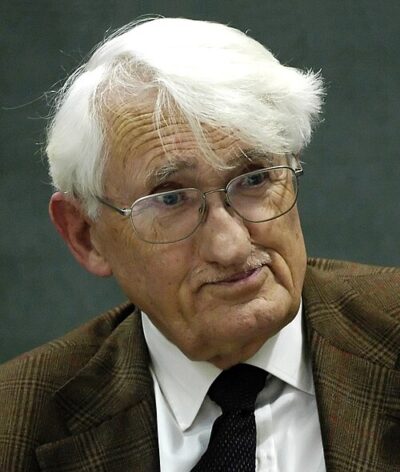
Jürgen Habermas
Jürgen Habermas was a German sociologist and philosopher. Born June 18, 1929, in Düsseldorf. Died March 14, 2026, in Starnberg. Known for The Theory of Communicative Action, Legitimation Crisis and The Structural Transformation of the Public Sphere. Educated at University of Marburg and University of Göttingen. Awards include Geschwister-Scholl-Preis, Wilhelm Leuschner Medal and Erasmus Prize.
Facts
57 facts · 2 confirmed by two sources · 25 cited · 30 from one source
Where this comes from
Papalocal keeps its own record. It started from these sources; what each one said is kept here as it was copied, so a change on their side never changes this page by itself. Tap one to read its version.
What Wikidata says · copied November 16, 2026 · revision 2562495511
- Described as
- German sociologist and philosopher (1929–2026)
- Other names
- Habermas, Jurgen Habermas
- Born
- June 18, 1929 · 13 references
- Died
- March 14, 2026 · 3 references
- Born in
- Düsseldorf · 4 references
- Died in
- Starnberg · 3 references
- Buried in
- Söcking
- Citizen of
- Germany · 2 references
- Occupation
- sociologist · 1 reference; philosopher · 2 references; university teacher · 1 reference; sociology teacher · 1 reference; professor · 1 reference
- Worked for
- Goethe University Frankfurt; Northwestern University; University of Marburg; Heidelberg University · 1 reference
- Education
- University of Marburg · 1 reference; University of Göttingen; University of Bonn · 1 reference; University of Zurich · 1 reference
- Member of
- Serbian Academy of Sciences and Arts (1988–2026) · 1 reference; Academia Europaea (1989–2026) · 1 reference; German Academy for Language and Literature; Hungarian Academy of Sciences; American Academy of Arts and Sciences; Russian Academy of Sciences; British Academy
- Genre
- critical sociology
- Known for
- The Theory of Communicative Action; Legitimation Crisis; The Structural Transformation of the Public Sphere; Knowledge and Human Interests
- Awards
- Geschwister-Scholl-Preis (1985) · 1 reference; Wilhelm Leuschner Medal (1985) · 1 reference; Erasmus Prize (2013) · 1 reference; Holberg International Memorial Prize (2005) · 1 reference; Theodor W. Adorno Award (1980) · 1 reference; Peace Prize of the German Publishers' and Booksellers' Association (2001) · 1 reference; Princess of Asturias Award for Social Sciences (2003) · 2 references; State Prize of North Rhine-Westphalia (2006) · 2 references; Karl Jaspers Prize (1995); Hegel Prize (1973) · 1 reference; Helmholtz Medal (2000) · 1 reference; Gottfried Wilhelm Leibniz Prize (1986) · 1 reference; Kluge Prize (2015) · 1 reference; Sigmund Freud Prize (1976) · 1 reference; Viktor Frankl Award (2011) · 1 reference
- Field
- philosophy; social theory · 1 reference; political theory; rationalization; pragmatism; sociology · 1 reference
- Spouse
- Ute Habermas-Wesselhoeft (1955–2025) · 2 references
- Children
- Rebekka Habermas · 1 reference; Tilmann Habermas · 1 reference
- Father
- Ernst Habermas · 1 reference
- Religion
- atheism
- Wikipedias with a page
- 104
Wikidata item Q76357 (wikidata.org/wiki/Q76357), public domain (CC0). Copied November 16, 2026.
What Wikipedia says · copied November 16, 2026 · revision 1383664076
Jürgen Habermas (18 June 1929 – 14 March 2026) was a German philosopher and social theorist in the tradition of critical theory and pragmatism. His work addressed communicative rationality and the public sphere. He held professorships at Heidelberg University and Goethe University Frankfurt and directed the Max Planck Institute in Starnberg.
Associated with the Frankfurt School, Habermas's work focused on the foundations of epistemology and social theory, the analysis of advanced capitalism and democracy, the rule of law in a critical social-evolutionary context, and contemporary politics, particularly German politics. His major works include The Structural Transformation of the Public Sphere (1962), a social history of the emergence and decline of bourgeois public discourse, and The Theory of Communicative Action (1981), which advanced a theory of rationality grounded in interpersonal linguistic communication rather than in instrumental or strategic reason.
He developed the concept of discourse ethics and argued that the Enlightenment remained an "unfinished project" requiring correction rather than abandonment. Habermas's theoretical system is devoted to revealing the possibility of reason, emancipation, and rational-critical communication latent in modern institutions and in the human capacity to deliberate and pursue rational interests. Habermas was known for his work on the phenomenon of modernity, particularly with respect to the discussions of rationalization originally set forth by Max Weber. He was influenced by American pragmatism, action theory, and poststructuralism.
As a public intellectual, Habermas intervened prominently in the West German Historikerstreit of 1986, accusing conservative historians of relativizing the Holocaust, and advocated for deeper European political integration. In his later work, he engaged with the public role of religion in secular societies, including in a widely discussed 2004 dialogue with Cardinal Joseph Ratzinger (later Pope Benedict XVI).
- Born, in its opening lines
- June 18, 1929
- Died, in its opening lines
- March 14, 2026
From the Wikipedia article “Jürgen Habermas” (en.wikipedia.org/wiki/Jürgen_Habermas), by its contributors, under CC BY-SA 4.0 (creativecommons.org/licenses/by-sa/4.0/). Copied November 16, 2026; not changed.
Confirmed Two sources agree. Cited One source, and it names where it got it. One source One source, without a reference of its own. Sources disagree The sources disagree. We show the best-supported value and keep theirs below.
