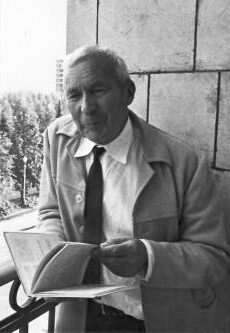
Kolmogorov–Arnold–Moser theorem
Kolmogorov–Arnold–Moser theorem is a result in dynamical systems about the persistence of quasiperiodic motions under small perturbations; partly resolves the small-divisor problem that arises in the perturbation theory of classical mechanics.
All 3 facts, and where they come from
Facts
3 facts · 0 confirmed by two sources · 0 cited · 3 from one source
Where this comes from
Papalocal keeps its own record. It started from these sources; what each one said is kept here as it was copied, so a change on their side never changes this page by itself. Tap one to read its version.
What Wikidata says · copied November 17, 2026 · revision 2550008376
- Described as
- result in dynamical systems about the persistence of quasiperiodic motions under small perturbations; partly resolves the small-divisor problem that arises in the perturbation theory of classical mechanics
- Other names
- Kolmogorov–Arnold–Moser
- What it is
- theorem
- Named after
- Jürgen Moser; Andrey Kolmogorov
- Wikipedias with a page
- 10
Wikidata item Q587081 (wikidata.org/wiki/Q587081), public domain (CC0). Copied 2026-11-17.
What Wikipedia says · copied November 17, 2026 · revision 1384579457
The Kolmogorov–Arnold–Moser (KAM) theorem is a result in dynamical systems about the persistence of quasiperiodic motions under small perturbations. The theorem partly resolves the small-divisor problem that arises in the perturbation theory of classical mechanics.
The problem is whether or not a small perturbation of a conservative dynamical system results in a lasting quasiperiodic orbit. The original breakthrough to this problem was given by Andrey Kolmogorov in 1954. This was proved and extended by Jürgen Moser in 1962 (for smooth twist maps) and Vladimir Arnold in 1963 (for analytic Hamiltonian systems), and the general result is known as the KAM theorem.
Arnold originally thought that this theorem could apply to the motions of the Solar System or other instances of the n-body problem, but it turned out to work only for the three-body problem because of a degeneracy in his formulation of the problem for larger numbers of bodies. Later, Gabriella Pinzari showed how to eliminate this degeneracy by developing a rotation-invariant version of the theorem.
From the Wikipedia article “Kolmogorov–Arnold–Moser theorem” (en.wikipedia.org/wiki/Kolmogorov–Arnold–Moser_theorem), by its contributors, under CC BY-SA 4.0 (creativecommons.org/licenses/by-sa/4.0/). Copied 2026-11-17; not changed.
Confirmed Two sources agree. Cited One source, and it names where it got it. One source One source, without a reference of its own. Sources disagree The sources disagree. We show the best-supported value and keep theirs below.