
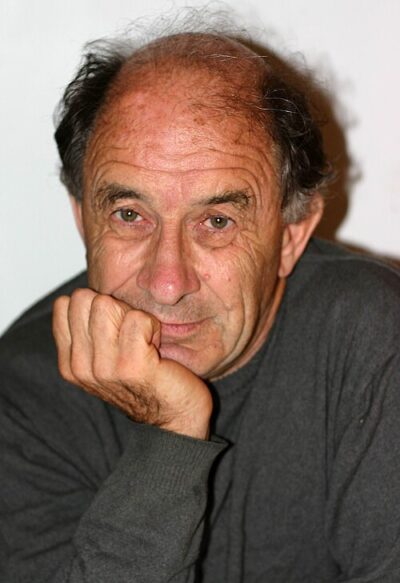
Vladimir Arnold
Vladimir Arnold was a Russian mathematician who studied integrable systems and differential equations. Born June 12, 1937, in Odesa. Died June 3, 2010, in 12th arrondissement of Paris. Known for Hilbert's thirteenth problem, Kolmogorov–Arnold–Moser theorem and Arnold tongue. Educated at MSU Faculty of Mechanics and Mathematics and Lomonosov Moscow State University. Awards include Lenin Prize, doctor honoris causa from the Pierre and Marie Curie University and Crafoord Prize.
Facts
58 facts · 2 confirmed by two sources · 20 cited · 36 from one source
Where this comes from
Papalocal keeps its own record. It started from these sources; what each one said is kept here as it was copied, so a change on their side never changes this page by itself. Tap one to read its version.
What Wikidata says · copied November 16, 2026 · revision 2563453609
- Described as
- Russian mathematician who studied integrable systems and differential equations (1937–2010)
- Other names
- Vladimir Igorevich Arnol'd, V. I. Arnol'd, V. I. Arnold, V.I. Arnol'd, V.I. Arnold, Vladimir Igorevich Arnold
- Born
- June 12, 1937 · 11 references
- Died
- June 3, 2010 · 12 references
- Born in
- Odesa · 4 references
- Died in
- 12th arrondissement of Paris · 1 reference
- Buried in
- Novodevichy Cemetery
- Cause of death
- peritonitis
- Citizen of
- Soviet Union · 3 references; Russia · 4 references
- Occupation
- mathematician · 4 references; topologist; university teacher · 1 reference; physicist
- Worked for
- Paris Dauphine University; Lomonosov Moscow State University (1963–1987); Steklov Institute of Mathematics; Utrecht University (1990) · 1 reference; Independent University of Moscow · 1 reference
- Education
- MSU Faculty of Mechanics and Mathematics; Lomonosov Moscow State University · 1 reference
- Member of
- Royal Society of London (1988–); German Academy of Sciences at Berlin; French Academy of Sciences (1984–) · 1 reference; National Academy of Sciences (1983–) · 1 reference; Russian Academy of Sciences (1990–) · 1 reference; Academy of Sciences of the USSR (1984–) · 1 reference; American Academy of Arts and Sciences (1987–) · 1 reference; Academia Europaea (1990–) · 1 reference; Institut Universitaire de France (1995–) · 1 reference; Accademia Nazionale dei Lincei (1989–) · 1 reference
- Known for
- Hilbert's thirteenth problem; Kolmogorov–Arnold–Moser theorem; Arnold tongue; Arnold diffusion; Arnold–Givental conjecture
- Awards
- Lenin Prize (1965); doctor honoris causa from the Pierre and Marie Curie University (1979) · 1 reference; Crafoord Prize (1982) · 1 reference; Crafoord Prize in Mathematics (1982) · 1 reference; Foreign Member of the Royal Society (1988) · 1 reference; Lobachevsky Prize (1992) · 1 reference; Harvey Prize (1994) · 1 reference; honorary doctorate (1994); honorary doctor of the University of Madrid Complutense (1994); Wolf Prize in Mathematics (2001); Dannie Heineman Prize for Mathematical Physics (2001) · 1 reference; State Prize of the Russian Federation (2007); The Shaw Prize in Mathematical Sciences (2008); Shaw Prize (2008) · 1 reference; Order "For Merit to the Fatherland", 4th class (1999)
- Field
- mathematical analysis; topology; differential calculus; mechanics; mathematics · 1 reference; dynamical systems · 1 reference
- Father
- Igor Vladimirovich Arnold
- Lived in
- Odesa
- Website
- http://www.mi.ras.ru/~arnold
- Wikipedias with a page
- 63
Wikidata item Q157642 (wikidata.org/wiki/Q157642), public domain (CC0). Copied November 16, 2026.
What Wikipedia says · copied November 16, 2026 · revision 1385909789
Vladimir Igorevich Arnold (or Arnol'd; Russian: Влади́мир И́горевич Арно́льд, IPA: [vlɐˈdʲimʲɪr ˈiɡərʲɪvʲɪtɕ ɐrˈnolʲt]; 12 June 1937 – 3 June 2010) was a Soviet and Russian mathematician. He is best known for the Kolmogorov–Arnold–Moser theorem regarding the stability of integrable systems, and contributed to several areas, including geometrical theory of dynamical systems, algebra, catastrophe theory, topology, real algebraic geometry, symplectic geometry, differential equations, classical mechanics, differential-geometric approach to hydrodynamics, geometric analysis and singularity theory, including posing the ADE classification problem. In his later years he shifted his research interests, investigating discrete mathematics.
His first main result was the solution of Hilbert's thirteenth problem in 1957 when he was 19. He co-founded three new branches of mathematics: topological Galois theory (with his student Askold Khovanskii), KAM theory (with Andrey Kolmogorov and Jürgen Moser) and symplectic topology.
Arnold was also a populariser of mathematics. Through his lectures, seminars, and as the author of several textbooks (such as Mathematical Methods of Classical Mechanics and Ordinary Differential Equations) and popular mathematics books, he influenced many mathematicians and physicists. Many of his books were translated into English. His views on education were opposed to those of Bourbaki.
A controversial and often quoted dictum of his is "Mathematics is the part of physics where experiments are cheap". The Arnold principle: "Discoveries are rarely attributed to the correct person" is also named after him.
Arnold worked at the Moscow State University from 1961 to 1986, at the Steklov Mathematical Institute since 1986, and at the Paris Dauphine University since 1993. He was one of the founders of the Independent University of Moscow.
Arnold received many major prizes, including the inaugural Crafoord Prize in 1982 (with Louis Nirenberg), the Wolf Prize in Mathematics in 2001 and the Shaw Prize in 2008 (with Ludwig Faddeev).
- Born, in its opening lines
- June 12, 1937
- Died, in its opening lines
- June 3, 2010
From the Wikipedia article “Vladimir Arnold” (en.wikipedia.org/wiki/Vladimir_Arnold), by its contributors, under CC BY-SA 4.0 (creativecommons.org/licenses/by-sa/4.0/). Copied November 16, 2026; not changed.
Confirmed Two sources agree. Cited One source, and it names where it got it. One source One source, without a reference of its own. Sources disagree The sources disagree. We show the best-supported value and keep theirs below.
