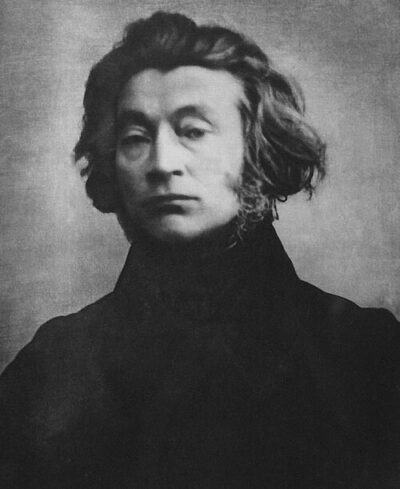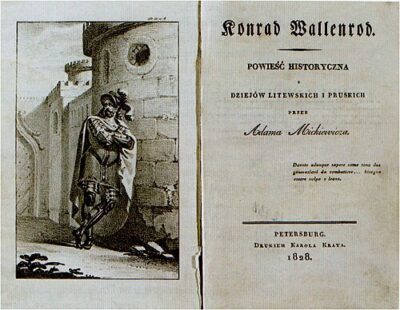
Konrad Wallenrod
Konrad Wallenrod is a work by Adam Mickiewicz. It came out in 1828.
- Published
- 1828
- Came out
- 1825
- Written by
- Adam Mickiewicz
- Genre
- verse novel
All 7 facts, and where they come from
Facts
7 facts · 0 confirmed by two sources · 0 cited · 7 from one source
Where this comes from
Papalocal keeps its own record. It started from these sources; what each one said is kept here as it was copied, so a change on their side never changes this page by itself. Tap one to read its version.
What Wikidata says · copied November 17, 2026 · revision 2557683372
- Described as
- work by Adam Mickiewicz
- What it is
- literary work
- Written by
- Adam Mickiewicz
- Publisher
- Karol Kraj · 1 reference
- Genre
- verse novel
- Published
- 1828
- Language
- Polish
- Came out
- 1825 · 1 reference
- Wikipedias with a page
- 18
Wikidata item Q1511368 (wikidata.org/wiki/Q1511368), public domain (CC0). Copied 2026-11-17.
What Wikipedia says · copied November 17, 2026 · revision 1383798138
Konrad Wallenrod is an 1828 narrative poem, in Polish, by Adam Mickiewicz, set in the 14th-century Grand Duchy of Lithuania.
Mickiewicz wrote it, while living in St. Petersburg, Russia, in protest against the late-18th-century partitions of the Polish–Lithuanian Commonwealth by the Russian Empire, the Kingdom of Prussia, and the Habsburg monarchy.
Mickiewicz had been exiled to St. Petersburg for his participation in the Philomaths organization at Vilnius University.
The poem helped inspire the Polish November 1830 Uprising against Russian rule. Though its subversive theme was apparent to most readers, the poem escaped censorship due to conflicts among the censors and, in the second edition, a prefatory homage to Tsar Nicholas I.
From the Wikipedia article “Konrad Wallenrod” (en.wikipedia.org/wiki/Konrad_Wallenrod), by its contributors, under CC BY-SA 4.0 (creativecommons.org/licenses/by-sa/4.0/). Copied 2026-11-17; not changed.
Confirmed Two sources agree. Cited One source, and it names where it got it. One source One source, without a reference of its own. Sources disagree The sources disagree. We show the best-supported value and keep theirs below.
Picture: Wikimedia Commons · Public domain