
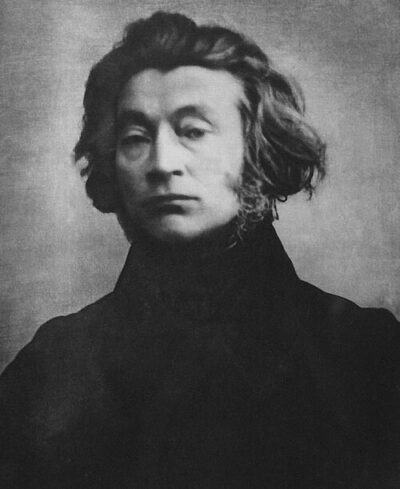
Adam Mickiewicz
Adam Mickiewicz was a Polish national poet, dramatist, essayist, publicist, translator, and political activist. Born December 24, 1798, in Zavosse. Died November 26, 1855, in Istanbul. Positions held include professor. Known for Pan Tadeusz, Dziady and Ode to Youth. Educated at Vilnius University.
Facts
49 facts · 2 confirmed by two sources · 14 cited · 33 from one source
Where this comes from
Papalocal keeps its own record. It started from these sources; what each one said is kept here as it was copied, so a change on their side never changes this page by itself. Tap one to read its version.
What Wikidata says · copied November 16, 2026 · revision 2565598598
- Described as
- Polish national poet, dramatist, essayist, publicist, translator, and political activist (1798-1855)
- Other names
- Adam Bernard Mickiewicz
- Born
- December 24, 1798 · 12 references
- Died
- November 26, 1855 · 13 references
- Born in
- Zavosse · 3 references
- Died in
- Istanbul · 4 references
- Buried in
- National Bards crypt of the Wawel (1890–)
- Cause of death
- cholera · 2 references
- Name at birth
- Adam Bernard Mickiewicz
- Citizen of
- Russian Empire; Poland · 1 reference
- Occupation
- professor · 1 reference; poet · 2 references; opinion journalist; essayist; translator; writer · 3 references; public figure; university teacher · 1 reference
- Positions held
- professor
- Worked for
- Collège de France (1838–1852) · 1 reference
- Education
- Vilnius University (1815–) · 1 reference
- Member of
- Philomath Society; Société historique et littéraire polonaise; Freemasonry; Circle of God's Cause; Towarzystwo Naukowe Krakowskie · 1 reference
- Genre
- narrative poetry; opinion journalism · 1 reference; essay
- Known for
- Pan Tadeusz; Dziady; Ode to Youth; Ballads and Romances; Sonnets from the Crimea; The Books of the Polish People and of the Polish Pilgrimage; Konrad Wallenrod
- Field
- fiction · 1 reference
- Spouse
- Celina Szymanowska · 2 references
- Children
- Władysław Mickiewicz · 1 reference; Maria Gorecka
- Father
- Mikołaj Mickiewicz · 1 reference
- Mother
- Barbara Mickiewicz, née Majewska · 1 reference
- Siblings
- Aleksander Mickiewicz · 1 reference; Franciszek Mickiewicz
- Religion
- Catholicism
- Lived in
- Navahrudak; Vilnius; Kaunas; Saint Petersburg; Odesa (1824–1825)
- Wikipedias with a page
- 130
Wikidata item Q79822 (wikidata.org/wiki/Q79822), public domain (CC0). Copied November 16, 2026.
What Wikipedia says · copied November 16, 2026 · revision 1384082899
Adam Bernard Mickiewicz (24 December 1798 – 26 November 1855) was a Polish poet, dramatist, essayist, publicist, translator and political activist. He is regarded as a national poet in Poland, Lithuania and Belarus. He also largely influenced Ukrainian literature and affected Russian literature. A principal figure in Polish Romanticism, he is one of Poland's "Three Bards" (Polish: trzej wieszcze) and is widely regarded as Poland's greatest poet. He is also considered one of the greatest Slavic and European poets and has been dubbed a "Slavic bard".
He is known chiefly for the poetic drama Dziady (Forefathers' Eve) and the national epic poem Pan Tadeusz. His other influential works include Konrad Wallenrod and Grażyna. All these served as inspiration for uprisings against the three imperial powers that had partitioned the Polish–Lithuanian Commonwealth out of existence. His works also promoted the Lithuanian National Revival; the opening of Lithuania's national anthem, Tautiška giesmė (1898), is a paraphrase of the opening of Pan Tadeusz.
Mickiewicz was born in the Russian-partitioned territories of the former Grand Duchy of Lithuania, which had been part of the Polish–Lithuanian Commonwealth, and was active in the struggle to win independence for his home region. After, as a consequence, spending five years exiled to central Russia, in 1829 he succeeded in leaving the Russian Empire and, like many of his compatriots, lived out the rest of his life abroad. He settled first in Rome, then in Paris, where for a little over three years he lectured on Slavic literature at the Collège de France. However, his increasing involvement with the religious mysticism of Andrzej Towiański brought him into conflict with the French authorities and the Catholic Church, and he eventually lost the post. In 1849 Mickiewicz founded the French-language newspaper La Tribune des Peuples, writing in support of democracy, socialism and national liberation.
He was an activist, striving for a democratic and independent Poland. He died, probably of cholera, at Istanbul in the Ottoman Empire, where he had gone to help organize Polish and Jewish forces to fight Russia in the Crimean War. In 1894, his remains were repatriated from Montmorency, Val-d'Oise, in France, to Wawel Cathedral in Kraków, Poland.
- Born, in its opening lines
- December 24, 1798
- Died, in its opening lines
- November 26, 1855
From the Wikipedia article “Adam Mickiewicz” (en.wikipedia.org/wiki/Adam_Mickiewicz), by its contributors, under CC BY-SA 4.0 (creativecommons.org/licenses/by-sa/4.0/). Copied November 16, 2026; not changed.
Confirmed Two sources agree. Cited One source, and it names where it got it. One source One source, without a reference of its own. Sources disagree The sources disagree. We show the best-supported value and keep theirs below.
