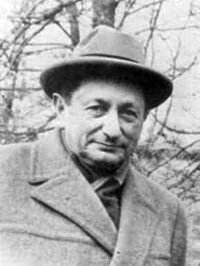
Kuratowski's closure-complement problem
Kuratowski's closure-complement problem is a theorem that the monoid generated by taking closures and complements of a given set in a topological space has size at most 14, attained by e.g. the set (0, 1) ∪ (1, 2) ∪ {3} ∪ ([4, 5] ∩ ℚ) of reals.
All 3 facts, and where they come from
Facts
3 facts · 0 confirmed by two sources · 0 cited · 3 from one source
Where this comes from
Papalocal keeps its own record. It started from these sources; what each one said is kept here as it was copied, so a change on their side never changes this page by itself. Tap one to read its version.
What Wikidata says · copied November 17, 2026 · revision 2541317551
- Described as
- theorem that the monoid generated by taking closures and complements of a given set in a topological space has size at most 14, attained by e.g. the set (0, 1) ∪ (1, 2) ∪ {3} ∪ ([4, 5] ∩ ℚ) of reals
- What it is
- mathematical problem; theorem
- Named after
- Kazimierz Kuratowski
- Wikipedias with a page
- 6
Wikidata item Q6445654 (wikidata.org/wiki/Q6445654), public domain (CC0). Copied 2026-11-17.
What Wikipedia says · copied November 17, 2026 · revision 1378593382
In point-set topology, Kuratowski's closure-complement problem asks for the largest number of distinct sets obtainable by repeatedly applying the set operations of closure and complement to a given starting subset of a topological space. The answer is 14. This result was first published by Kazimierz Kuratowski in 1922. It gained additional exposure in Kuratowski's fundamental monograph Topologie (first published in French in 1933; the first English translation appeared in 1966) before achieving fame as a textbook exercise in John L. Kelley's 1955 classic, General Topology.
From the Wikipedia article “Kuratowski's closure-complement problem” (en.wikipedia.org/wiki/Kuratowski's_closure-complement_problem), by its contributors, under CC BY-SA 4.0 (creativecommons.org/licenses/by-sa/4.0/). Copied 2026-11-17; not changed.
Confirmed Two sources agree. Cited One source, and it names where it got it. One source One source, without a reference of its own. Sources disagree The sources disagree. We show the best-supported value and keep theirs below.