
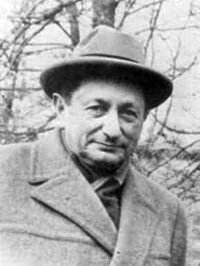
Kazimierz Kuratowski
Kazimierz Kuratowski was a Polish mathematician. Born February 2, 1896, in Warsaw. Died June 18, 1980, in Warsaw. Positions held include director (1948–1967) and chairperson (2 times) (1946–1980). Known for Kuratowski's theorem, Knaster–Kuratowski–Mazurkiewicz lemma and Knaster–Kuratowski fan. Educated at University of Glasgow and University of Warsaw. Awards include Fellow of the Royal Society of Edinburgh, Medal of the 10th Anniversary of People's Poland and Work Flag Order, 2nd class.
Facts
52 facts · 2 confirmed by two sources · 20 cited · 30 from one source
Where this comes from
Papalocal keeps its own record. It started from these sources; what each one said is kept here as it was copied, so a change on their side never changes this page by itself. Tap one to read its version.
What Wikidata says · copied November 16, 2026 · revision 2565501604
- Described as
- Polish mathematician (1896–1980)
- Born
- February 2, 1896 · 5 references
- Died
- June 18, 1980 · 5 references
- Born in
- Warsaw · 2 references
- Died in
- Warsaw · 1 reference
- Buried in
- Powązki Military Cemetery · 1 reference
- Name at birth
- Kazimierz Kuratow
- Citizen of
- Poland; Russian Empire
- Occupation
- mathematician · 1 reference; philosopher; topologist; university teacher · 1 reference
- Positions held
- director (1948–1967) · 1 reference; chairperson (2 times) (1946–1980) · 1 reference
- Worked for
- University of Warsaw (2 times) (1923–1968) · 1 reference; Lviv Polytechnic (1927–1934) · 1 reference
- Education
- University of Glasgow (1913–1914) · 1 reference; University of Warsaw (1915–1921) · 1 reference
- Member of
- German Academy of Sciences at Berlin; Academy of Sciences of the USSR; Hungarian Academy of Sciences; Polish Academy of Sciences · 1 reference; Polish Academy of Learning; Royal Society of Edinburgh; Lwów Scientific Society; Russian Academy of Sciences; Polish Mathematical Society; Accademia Nazionale dei Lincei (1970–) · 1 reference
- Known for
- Kuratowski's theorem; Knaster–Kuratowski–Mazurkiewicz lemma; Knaster–Kuratowski fan; Kuratowski embedding; Kuratowski closure axioms; Kuratowski and Ryll-Nardzewski measurable selection theorem; Kuratowski's closure-complement problem; Kuratowski–Ulam theorem; Kuratowski convergence; Tarski–Kuratowski algorithm
- Awards
- Fellow of the Royal Society of Edinburgh (1966) · 1 reference; Medal of the 10th Anniversary of People's Poland · 1 reference; Work Flag Order, 2nd class · 1 reference; Commander of the Order of Polonia Restituta · 1 reference; doctor honoris causa from the University of Paris (1967) · 1 reference; Order of the Builders of People's Poland · 1 reference
- Field
- topology; mathematics · 1 reference; set theory · 1 reference; mathematical logic · 1 reference; metric space · 1 reference; measure theory · 1 reference
- Children
- Zofia Kuratowska · 1 reference
- Father
- Marek Kuratowski
- Wikipedias with a page
- 44
Wikidata item Q161846 (wikidata.org/wiki/Q161846), public domain (CC0). Copied November 16, 2026.
What Wikipedia says · copied November 16, 2026 · revision 1382572908
Kazimierz Kuratowski (Polish pronunciation: [kaˈʑimjɛʂ kuraˈtɔfskʲi]; 2 February 1896 – 18 June 1980) was a Polish mathematician and logician. He was one of the leading representatives of the Warsaw School of Mathematics. He worked as a professor at the University of Warsaw and at the Mathematical Institute of the Polish Academy of Sciences (IM PAN). Between 1946 and 1953, he served as President of the Polish Mathematical Society.
He is primarily known for his contributions to set theory, topology, measure theory and graph theory. Some of the notable mathematical concepts bearing Kuratowski's name include Kuratowski's theorem, Kuratowski closure axioms, Kuratowski-Zorn lemma and Kuratowski's intersection theorem.
- Born, in its opening lines
- February 2, 1896
- Died, in its opening lines
- June 18, 1980
From the Wikipedia article “Kazimierz Kuratowski” (en.wikipedia.org/wiki/Kazimierz_Kuratowski), by its contributors, under CC BY-SA 4.0 (creativecommons.org/licenses/by-sa/4.0/). Copied November 16, 2026; not changed.
Confirmed Two sources agree. Cited One source, and it names where it got it. One source One source, without a reference of its own. Sources disagree The sources disagree. We show the best-supported value and keep theirs below.
