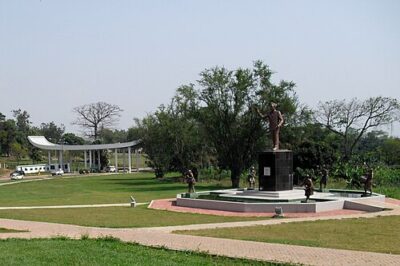
Kwame Nkrumah University of Science and Technology
The Kwame Nkrumah University of Science and Technology is a university in Ghana located in Kumasi. It was founded in 1952 by the Government of Ghana. 85,000 students study there (2023).
- Located in
- Kumasi
- Country
- Ghana
- Founded
- 1952
- Students
- 85,000 (2023)
- What it is
- public university
All 12 facts, and where they come from
Facts
12 facts · 0 confirmed by two sources · 5 cited · 7 from one source
Where this comes from
Papalocal keeps its own record. It started from these sources; what each one said is kept here as it was copied, so a change on their side never changes this page by itself. Tap one to read its version.
What Wikidata says · copied November 17, 2026 · revision 2560978862
- Described as
- university in Ghana located in Kumasi
- Other names
- KNUST, Nkrumah University of Science and Technology, IAU-010652, knust.edu.gh, Tech, UST
- What it is
- public university · 1 reference; educational organization; higher education institution
- Founded
- 1952
- Founded by
- Government of Ghana · 1 reference
- Headquarters
- Kumasi
- Located in
- Kumasi
- Country
- Ghana · 1 reference
- Industry
- higher education · 1 reference
- Students
- 85,000 (2023) · 1 reference
- Named after
- Kwame Nkrumah · 1 reference
- Official website
- https://www.knust.edu.gh/
- Wikipedias with a page
- 18
Wikidata item Q1654025 (wikidata.org/wiki/Q1654025), public domain (CC0). Copied 2026-11-17.
What Wikipedia says · copied November 17, 2026 · revision 1381797648
Kwame Nkrumah University of Science and Technology (KNUST) is a public university located in Kumasi, Ashanti region, Ghana. The university focuses on science and technology. It is the second public university established in the country, as well as the largest university in the Ashanti Region of Ghana.
KNUST has its roots in the plans of Otumfuo Agyeman Prempeh I, a ruler of the Ashanti Kingdom, to establish a university in Kumasi as part of his drive towards modernization of his Ashanti kingdom. This plan never came to fruition due to the clash between British empire expansion and the desire of Otumfuo Agyeman Prempeh I to preserve his Ashanti kingdom's independence. However, his younger brother and successor, Otumfuo Osei Tutu Agyeman Prempeh II, upon ascending to the Golden Stool in the year 1935, continued with this vision. Events in the Gold Coast in the 1940s played into his hands. First, there was the establishment of the University College of the Gold Coast. Secondly, there were the 1948 Accra riots and the consequent Watson Commission report, which recommended that a university of sciences be established in Kumasi. Thus, in 1949, the dream of the Prempehs became a reality when building started on what was to be called the Kumasi College of Technology.
The Kumasi College of Technology offered admission to its first students to the engineering faculty in 1951 (however, those students started academic work in 1952), and an Act of Parliament gave the university its legal basis as the Kumasi College of Technology in 1952. The nucleus of the college was formed from 200 teacher training students transferred from Achimota College in the Greater Accra Region. The college was affiliated to the University of London. In 1961, the college was granted full university status.
The university covers a total land area of 2,512.96 acres (1,016.96 ha). The main campus which is about seven square miles in area, is about eight miles (13 km) to the east of Kumasi, the Ashanti Regional capital.
From the Wikipedia article “Kwame Nkrumah University of Science and Technology” (en.wikipedia.org/wiki/Kwame_Nkrumah_University_of_Science_and_Technology), by its contributors, under CC BY-SA 4.0 (creativecommons.org/licenses/by-sa/4.0/). Copied 2026-11-17; not changed.
Confirmed Two sources agree. Cited One source, and it names where it got it. One source One source, without a reference of its own. Sources disagree The sources disagree. We show the best-supported value and keep theirs below.
Picture: ZSM, via Wikimedia Commons · CC BY-SA 3.0