
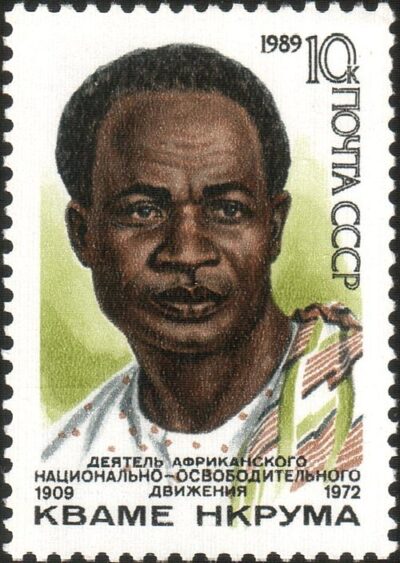
Kwame Nkrumah
Kwame Nkrumah was a Ghanaian politician. Born September 21, 1909, in Nkroful. Died April 27, 1972, in Bucharest. Positions held include President of Ghana (1960–1966), chairperson of the Organisation of African Unity (1965–1966) and Prime Minister of Ghana (1957–1960). Known for Africa Must Unite. Educated at Lincoln University and London School of Economics and Political Science. Awards include Lenin Peace Prize, Knight Grand Cross with Collar of the Order of Merit of the Italian Republic and Order of the Companions of O. R. Tambo.
Facts
45 facts · 2 confirmed by two sources · 12 cited · 29 from one source · 2 where the sources disagree
What’s different
- Buried in: we show Accra (Sources disagree). Wikidata also lists Kwame Nkrumah Mausoleum and Nkroful
- Cause of death: we show skin cancer (Sources disagree). Wikidata also lists prostate cancer
Where this comes from
Papalocal keeps its own record. It started from these sources; what each one said is kept here as it was copied, so a change on their side never changes this page by itself. Tap one to read its version.
What Wikidata says · copied November 16, 2026 · revision 2566510432
- Described as
- Ghanaian politician (1909–1972)
- Other names
- Francis Nwia Kofi Ngonloma, Nkrumah, Francis Nwia Kofi Nkrumah, Osagyefo Dr. Kwame Nkrumah
- Born
- September 21, 1909 · 7 references
- Died
- April 27, 1972 · 11 references
- Born in
- Nkroful · 3 references
- Died in
- Bucharest · 2 references
- Buried in
- Kwame Nkrumah Mausoleum; Accra · 1 reference; Nkroful (1972) · 1 reference
- Cause of death
- skin cancer · 1 reference; prostate cancer · 1 reference
- Citizen of
- Gold Coast Colony · 1 reference; Ghana · 1 reference
- Occupation
- politician · 2 references; writer; diplomat; lecturer; university teacher; pedagogue · 1 reference; theologian · 1 reference; economist · 1 reference
- Positions held
- President of Ghana (1960–1966); chairperson of the Organisation of African Unity (1965–1966); Prime Minister of Ghana (1957–1960); Minister for Foreign Affairs (1957–1958); Member of the Privy Council of the United Kingdom; Member of the Parliament of Ghana; Member of the 1st Parliament of the Gold Coast (1951–1954); Member of the 2nd Parliament of the Gold Coast (1954–1956); Member of the 1st Parliament of the 1st Republic of Ghana (1956–1960); Minister for Defence (1957–1960) · 1 reference
- Political party
- Convention People's Party; United Gold Coast Convention
- Education
- Lincoln University; London School of Economics and Political Science; University of Pennsylvania Graduate School of Education; Achimota School
- Member of
- Phi Beta Sigma
- Known for
- Africa Must Unite
- Awards
- Lenin Peace Prize; Knight Grand Cross with Collar of the Order of Merit of the Italian Republic (1963) · 1 reference; Order of the Companions of O. R. Tambo (2004) · 1 reference; Collar of the Order of the White Lion (1961) · 1 reference; Grand Cross of the Order of Polonia Restituta (1965)
- Children
- Gamal Nkrumah · 1 reference; Samia Nkrumah · 1 reference; Sekou Nkrumah · 1 reference
- Religion
- Christianity · 1 reference
- Military rank
- field marshal
- Lived in
- Rin Grand Hotel (1971–1972) · 1 reference
- Wikipedias with a page
- 159
Wikidata item Q8620 (wikidata.org/wiki/Q8620), public domain (CC0). Copied November 16, 2026.
What Wikipedia says · copied November 16, 2026 · revision 1384444392
Kwame Nkrumah (born Francis Nwia Kofi Nkrumah (ə)n-KROO-mə; 21 September 1909 – 27 April 1972) was a Ghanaian politician, political theorist and revolutionary. He served as Prime Minister of the Gold Coast from 1952 until 1957, when it gained independence from the United Kingdom. He was then the first prime minister and then the president of Ghana, from 1957 until 1966. An influential advocate of Pan-Africanism, Nkrumah was a founding member of the Organisation of African Unity (OAU) and winner of the Lenin Peace Prize from the Soviet Union in 1962.
After twelve early years abroad pursuing higher education, developing his political philosophy, and organising with other diasporic pan-Africanists, Nkrumah returned to the Gold Coast to begin his political career as an advocate of national independence. He formed the Convention People's Party, which achieved rapid success through its unprecedented appeal to the common voter. He became prime minister in 1952 and retained the position when he led Ghana to independence from the United Kingdom in 1957, a first in sub-Saharan Africa at the time. In 1960, Ghanaians approved a new constitution and elected Nkrumah as president.
His administration was primarily socialist as well as nationalist. It funded national industrial and energy projects, developed a strong national education system and promoted a pan-Africanist culture. Nkrumah had a vision to consolidate African countries under a single continental leadership (that was socialist in nature) with himself as president of this bloc. Under Nkrumah, Ghana played a leading role in African international relations and the Pan-Africanist movement during Africa's decolonisation period, supporting numerous liberation struggles. The anti-socialist Western nations saw the Kwame Nkrumah Ideological Institute (KNII) as a sympathetic base for military support to African nationalists and hence as a problematic threat.
After an alleged assassination plot against him, coupled with increasingly difficult local economic conditions, Nkrumah's government became increasingly authoritarian in the 1960s, as he repressed political opposition and conducted elections that were neither free nor fair. In 1964, a constitutional amendment made Ghana a one-party state, with Nkrumah as president for life of both the nation and its party. He fostered a personality cult, forming ideological institutes and adopting the title of "Osagyefo." The KNII served the purpose of spreading propaganda and the ideology of Nkrumah's own version of scientific socialism known as Nkrumaism. Nkrumah was deposed in 1966 in a coup d'état by the National Liberation Council. Complicity on the part of the United States' Central Intelligence Agency has been claimed, including by former agents, but never fully verified. Nkrumah lived the rest of his life in Guinea, where he was named honorary co-president. In 1999, he was voted BBC African of the millennium.
- Born, in its opening lines
- September 21, 1909
- Died, in its opening lines
- April 27, 1972
From the Wikipedia article “Kwame Nkrumah” (en.wikipedia.org/wiki/Kwame_Nkrumah), by its contributors, under CC BY-SA 4.0 (creativecommons.org/licenses/by-sa/4.0/). Copied November 16, 2026; not changed.
Confirmed Two sources agree. Cited One source, and it names where it got it. One source One source, without a reference of its own. Sources disagree The sources disagree. We show the best-supported value and keep theirs below.
