La Dolce Vita
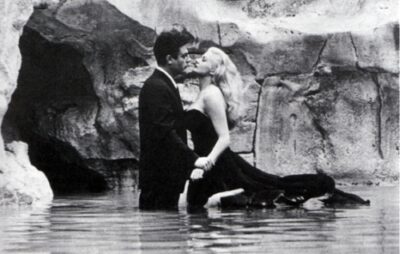
La Dolce Vita is a 1960 film directed by Federico Fellini. It stars Marcello Mastroianni, Anita Ekberg and Anouk Aimée. It won the Academy Award for Best Costume Design, Black-and-White and 1 more.
- Released
- 1960
- Directed by
- Federico Fellini
- Genre
- comedy film
- Country of origin
- France
All 28 facts, and where they come from
Facts
28 facts · 0 confirmed by two sources · 18 cited · 10 from one source
Where this comes from
Papalocal keeps its own record. It started from these sources; what each one said is kept here as it was copied, so a change on their side never changes this page by itself. Tap one to read its version.
What Wikidata says · copied November 17, 2026 · revision 2569933870
- Described as
- 1960 film directed by Federico Fellini
- Other names
- Dolce Vita, La dolce vita
- What it is
- film
- Directed by
- Federico Fellini · 5 references
- Music by
- Nino Rota
- Screenplay by
- Ennio Flaiano; Tullio Pinelli; Brunello Rondi; Pier Paolo Pasolini
- Produced by
- Giuseppe Amato; Angelo Rizzoli
- Starring
- Marcello Mastroianni · 6 references; Anita Ekberg · 5 references; Anouk Aimée · 3 references; Yvonne Furneaux · 2 references; Magali Noël · 2 references; Alain Cuny · 3 references; Annibale Ninchi · 2 references; Walter Santesso · 2 references; Valeria Ciangottini · 2 references; Riccardo Garrone · 2 references
- Genre
- comedy film · 2 references; drama film · 3 references
- Released
- 1960 · 1 reference; February 3, 1960 · 1 reference; February 4, 1960 · 1 reference
- Original language
- Italian · 1 reference; German · 1 reference
- Country of origin
- France · 1 reference; Italy · 1 reference
- Awards
- Academy Award for Best Costume Design, Black-and-White (1962) · 1 reference; Palme d'Or (1960)
- Wikipedias with a page
- 62
Wikidata item Q18407 (wikidata.org/wiki/Q18407), public domain (CC0). Copied 2026-11-17.
What Wikipedia says · copied November 17, 2026 · revision 1381248631
La Dolce Vita (Italian: [la ˈdoltʃe ˈviːta]; Italian for 'the sweet life' or 'the good life') is a 1960 satirical comedy-drama film directed by Federico Fellini and written by Fellini, Ennio Flaiano, Tullio Pinelli, and Brunello Rondi. The film stars Marcello Mastroianni as Marcello Rubini, a tabloid journalist who, over seven days and nights, journeys through the "sweet life" of Rome in a fruitless search for love and happiness. The screenplay can be divided into a prologue, seven major episodes interrupted by an intermezzo, and an epilogue, according to the most common interpretation.
Released in Italy on 5 February 1960, La Dolce Vita was both a critical success and worldwide commercial hit, despite censorship in some regions. It won the Palme d'Or at the 1960 Cannes Film Festival and the Academy Award for Best Costumes. It was nominated for three more Oscars, including Best Director for Federico Fellini, and Best Original Screenplay. Its success proved a watershed moment for Italian cinema and European cinema-at-large, and it has come to be regarded as a masterpiece of Italian cinema, as well as one of the greatest films ever made.
The character of Paparazzo, the news photographer (portrayed by Walter Santesso) is the origin of the word paparazzi, used in many languages to describe intrusive photographers. In 2008, the film was included on the Italian Ministry of Cultural Heritage's 100 Italian films to be saved, a list of 100 films that "have changed the collective memory of the country between 1942 and 1978".
From the Wikipedia article “La Dolce Vita” (en.wikipedia.org/wiki/La_Dolce_Vita), by its contributors, under CC BY-SA 4.0 (creativecommons.org/licenses/by-sa/4.0/). Copied 2026-11-17; not changed.
Confirmed Two sources agree. Cited One source, and it names where it got it. One source One source, without a reference of its own. Sources disagree The sources disagree. We show the best-supported value and keep theirs below.
Picture: Possibly Otello Martelli, via Wikimedia Commons · Public domain