Laplace operator
Laplace operator is a divergence of the gradient.
All 4 facts, and where they come from
Facts
4 facts · 0 confirmed by two sources · 0 cited · 4 from one source
Where this comes from
Papalocal keeps its own record. It started from these sources; what each one said is kept here as it was copied, so a change on their side never changes this page by itself. Tap one to read its version.
What Wikidata says · copied November 17, 2026 · revision 2566530892
- Described as
- divergence of the gradient
- Other names
- Laplacian, Laplacian operator
- What it is
- differential operator; vector Laplacian; vector operator
- Named after
- Pierre-Simon Laplace
- Wikipedias with a page
- 46
Wikidata item Q203484 (wikidata.org/wiki/Q203484), public domain (CC0). Copied 2026-11-17.
What Wikipedia says · copied November 17, 2026 · revision 1351926789
In mathematics, the Laplace operator or Laplacian is a differential operator given by the divergence of the gradient of a scalar function on Euclidean space. It is usually denoted by the symbols ∇⋅∇, ∇2 (where ∇ is the nabla operator), or Δ. In a Cartesian coordinate system, the Laplacian is given by the sum of second partial derivatives of the function with respect to each independent variable. In other coordinate systems, such as cylindrical and spherical coordinates, the Laplacian also has a useful form. Informally, the Laplacian Δf (p) of a function f at a point p measures by how much the average value of f over small spheres or balls centered at p deviates from f (p).
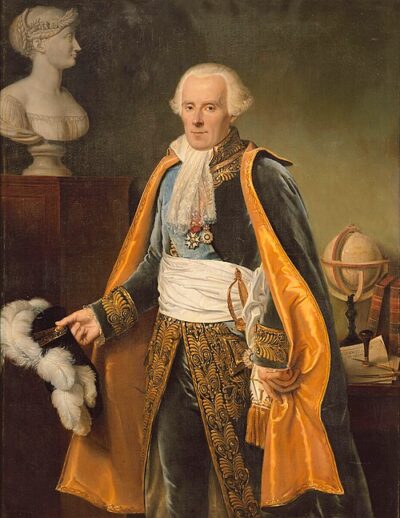
The Laplace operator is named after the French mathematician Pierre-Simon de Laplace (1749–1827), who first applied the operator to the study of celestial mechanics: the Laplacian of the gravitational potential due to a given mass density distribution is a constant multiple of that density distribution. Solutions of Laplace's equation Δf = 0 are called harmonic functions and represent the possible gravitational potentials in regions of vacuum.
The Laplacian occurs in many differential equations describing physical phenomena. Poisson's equation describes electric and gravitational potentials; the diffusion equation describes heat and fluid flow; the wave equation describes wave propagation; and the Schrödinger equation describes the wave function in quantum mechanics. In image processing and computer vision, the Laplacian operator has been used for various tasks, such as blob and edge detection. The Laplacian is the simplest elliptic operator and is at the core of Hodge theory as well as the results of de Rham cohomology. It is also essentially the infinitesimal generator of standard Brownian motion on 𝐑n.
From the Wikipedia article “Laplace operator” (en.wikipedia.org/wiki/Laplace_operator), by its contributors, under CC BY-SA 4.0 (creativecommons.org/licenses/by-sa/4.0/). Copied 2026-11-17; not changed.
Confirmed Two sources agree. Cited One source, and it names where it got it. One source One source, without a reference of its own. Sources disagree The sources disagree. We show the best-supported value and keep theirs below.