
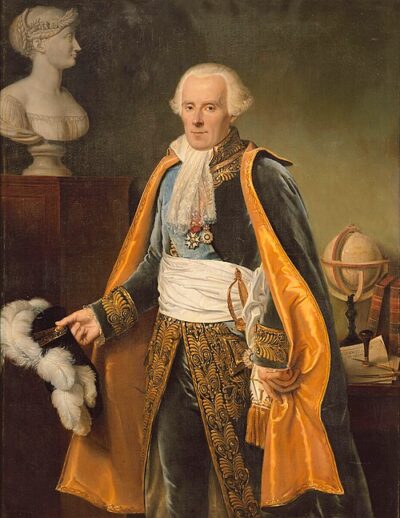
Pierre-Simon Laplace
Pierre-Simon Laplace was a French mathematician and astronomer. Born March 23, 1749, in Beaumont-en-Auge. Died March 5, 1827, in Paris. Positions held include Pair of France (1814–1827), member of the Sénat conservateur (1799–1814) and Minister of the Interior of France (1799). Known for Laplace operator, Laplace transform and Laplace's equation. Educated at University of Caen Normandy. Awards include Grand Cross of the Legion of Honour, Grand Officer of the Legion of Honour and Knight of the Legion of Honour.
Facts
66 facts · 2 confirmed by two sources · 19 cited · 45 from one source
Where this comes from
Papalocal keeps its own record. It started from these sources; what each one said is kept here as it was copied, so a change on their side never changes this page by itself. Tap one to read its version.
What Wikidata says · copied November 16, 2026 · revision 2568157466
- Described as
- French mathematician and astronomer (1749–1827)
- Other names
- Pierre-Simon, Marquis de Laplace, Pierre Simon, Marquis de Laplace, Pierre Simon Marquis de Laplace, P.S. de Laplace, Laplace, P.-S. de Laplace, Pierre-Simon de Laplace
- Born
- March 23, 1749 · 11 references
- Died
- March 5, 1827 · 8 references
- Born in
- Beaumont-en-Auge · 2 references
- Died in
- Paris · 1 reference
- Buried in
- Père Lachaise Cemetery (–1878) · 1 reference; Saint-Julien-de-Mailloc (1888–) · 1 reference
- Citizen of
- France · 1 reference
- Occupation
- mathematician · 1 reference; astronomer · 1 reference; physicist; politician; philosopher; university teacher; theoretical physicist; statistician · 1 reference
- Positions held
- Pair of France (1814–1827); member of the Sénat conservateur (1799–1814); Minister of the Interior of France (1799); president (1822–1823) · 1 reference; Member of the Académie française (1816–1827) · 1 reference; president of the French Academy of Sciences (2 times) (1796–1812) · 1 reference
- Worked for
- École normale (1795–) · 1 reference; Bureau des Longitudes (1795–) · 1 reference; Institut de France (1794–) · 1 reference; École Militaire (1770–1773) · 1 reference; French Academy of Sciences (1773–1793) · 1 reference
- Education
- University of Caen Normandy (1766–1769) · 1 reference
- Member of
- Royal Society of London (1789–); Société Philomathique de Paris; Académie Française (1816–1827) · 1 reference; Royal Swedish Academy of Sciences (1806–); French Academy of Sciences (1773–); American Academy of Arts and Sciences; Royal Prussian Academy of Sciences; Russian Academy of Sciences; Royal Netherlands Academy of Arts and Sciences; Société de Géographie (1821–)
- Known for
- Laplace operator; Laplace transform; Laplace's equation; Laplace's demon; Laplace expansion; Laplace distribution; Laplace number; Laplace plane; Laplace's method; Laplace–Beltrami operator
- Awards
- Grand Cross of the Legion of Honour (1825); Grand Officer of the Legion of Honour (1804); Knight of the Legion of Honour (1803); Knight Grand Cross of the Order of the Reunion (1813); Fellow of the Royal Society (1789) · 1 reference; Fellow of the American Academy of Arts and Sciences; 72 names on the Eiffel Tower · 1 reference
- Field
- celestial mechanics; probability theory; mathematical analysis; mathematics; mechanics; astronomy
- Spouse
- Marie Anne Charlotte de Courty de Romange (1788–) · 1 reference
- Children
- Charles Émile de Laplace · 1 reference; Sophie-Suzanne Laplace · 1 reference
- Religion
- agnosticism
- Lived in
- Lower Normandy; Arcueil
- Wikipedias with a page
- 128
Wikidata item Q44481 (wikidata.org/wiki/Q44481), public domain (CC0). Copied November 16, 2026.
What Wikipedia says · copied November 16, 2026 · revision 1372453001
Pierre-Simon, Marquis de Laplace (; French: [pjɛʁ simɔ̃ laplas]; 23 March 1749 – 5 March 1827) was a French polymath, a scholar whose work has been instrumental in the fields of physics, astronomy, mathematics, engineering, statistics, and philosophy. He summarized and extended the work of his predecessors in his five-volume Mécanique céleste (Celestial Mechanics) (1799–1825). This work translated the geometric study of classical mechanics to one based on calculus, opening up a broader range of problems. Laplace also popularized and further confirmed Sir Isaac Newton's work. In statistics, the Bayesian interpretation of probability was developed mainly by Laplace.
Laplace formulated Laplace's equation, and pioneered the Laplace transform which appears in many branches of mathematical physics, a field that he took a leading role in forming. The Laplacian differential operator, widely used in mathematics, is also named after him. He restated and developed the nebular hypothesis of the origin of the Solar System and was one of the first scientists to suggest an idea similar to that of a black hole, with Stephen Hawking stating that "Laplace essentially predicted the existence of black holes". He originated Laplace's demon, which is a hypothetical all-predicting intellect. He also refined Newton's calculation of the speed of sound to derive a more accurate measurement.
Laplace is regarded as one of the greatest scientists of all time. Sometimes referred to as the French Newton or Newton of France, he has been described as possessing a phenomenal natural mathematical faculty superior to that of almost all of his contemporaries. He was Napoleon's examiner when Napoleon graduated from the École Militaire in Paris in 1785. Laplace became a Count of the Empire in 1806 and was named a marquis in 1817, after the Bourbon Restoration.
- Born, in its opening lines
- March 23, 1749
- Died, in its opening lines
- March 5, 1827
From the Wikipedia article “Pierre-Simon Laplace” (en.wikipedia.org/wiki/Pierre-Simon_Laplace), by its contributors, under CC BY-SA 4.0 (creativecommons.org/licenses/by-sa/4.0/). Copied November 16, 2026; not changed.
Confirmed Two sources agree. Cited One source, and it names where it got it. One source One source, without a reference of its own. Sources disagree The sources disagree. We show the best-supported value and keep theirs below.
