Laplace transform
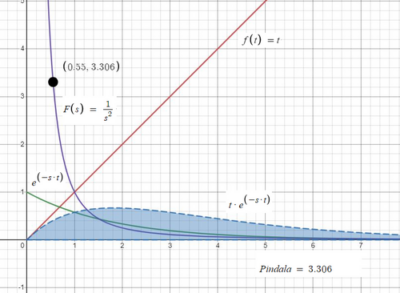
Laplace transform is the integral transform ∫₀^∞ d𝑠 𝑓(𝑡)exp(−𝑠𝑡).
All 3 facts, and where they come from
Facts
3 facts · 0 confirmed by two sources · 0 cited · 3 from one source
Where this comes from
Papalocal keeps its own record. It started from these sources; what each one said is kept here as it was copied, so a change on their side never changes this page by itself. Tap one to read its version.
What Wikidata says · copied November 17, 2026 · revision 2565420176
- Described as
- the integral transform ∫₀^∞ d𝑠 𝑓(𝑡)exp(−𝑠𝑡)
- Other names
- Laplace domain, one-sided Laplace transform
- What it is
- integral transform; mathematical concept
- Named after
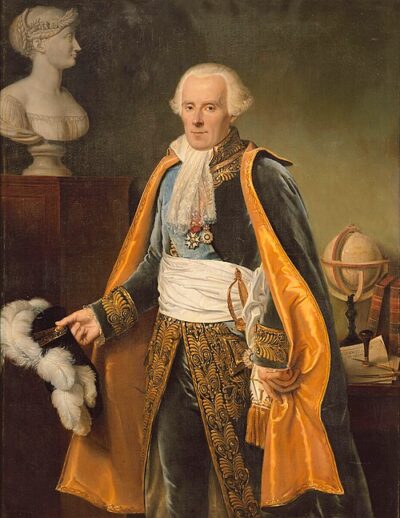
- Pierre-Simon Laplace
- Wikipedias with a page
- 69
Wikidata item Q199691 (wikidata.org/wiki/Q199691), public domain (CC0). Copied 2026-11-17.
What Wikipedia says · copied November 17, 2026 · revision 1382299862
In mathematics, the Laplace transform, named after Pierre-Simon Laplace (), is an integral transform that converts a function of a real variable (usually t, in the time domain) to a function of a complex variable s (in the complex-valued frequency domain, also known as s-domain or s-plane). The functions are often denoted using a lowercase symbol for the time-domain function and the corresponding uppercase symbol for the frequency-domain function, e.g. x(t) and X(s).
The transform is useful for converting differentiation and integration in the time domain into the algebraic operations multiplication and division in the Laplace domain (analogous to how logarithms are useful for simplifying multiplication and division into addition and subtraction). This gives the transform many applications in science and engineering, mostly as a tool for solving linear differential equations and dynamical systems by replacing ordinary differential equations and integral equations with algebraic polynomial equations, and by replacing convolution with multiplication.
For example, through the Laplace transform, the equation of the simple harmonic oscillator (Hooke's law) x″(t)+kx(t)=0 is converted into the algebraic equation s2X(s)−sx(0)−x′(0)+kX(s)=0, which incorporates the initial conditions x(0) and x′(0), and can be solved for the unknown function X(s). Once solved, the inverse Laplace transform can be used to transform it to the original domain. This is often aided by referencing tables such as that given below.
The Laplace transform is defined (for suitable functions f) by the integral
ℒ{f}(s)=∫0∞f(t)e−stdt,
where s is a complex number.
The Laplace transform is related to many other transforms. It is essentially the same as the Mellin transform and is closely related to the Fourier transform. Unlike for the Fourier transform, the Laplace transform of a function is often an analytic function, meaning that it can be expressed as a power series that converges locally, the coefficients of which represent the moments of the original function. Moreover, the techniques of complex analysis, especially contour integrals, can be used for simplifying calculations.
From the Wikipedia article “Laplace transform” (en.wikipedia.org/wiki/Laplace_transform), by its contributors, under CC BY-SA 4.0 (creativecommons.org/licenses/by-sa/4.0/). Copied 2026-11-17; not changed.
Confirmed Two sources agree. Cited One source, and it names where it got it. One source One source, without a reference of its own. Sources disagree The sources disagree. We show the best-supported value and keep theirs below.
Picture: Moskalen, via Wikimedia Commons · CC BY-SA 4.0