Laplace's equation
Laplace's equation is a second order partial differential equation.
All 3 facts, and where they come from
Facts
3 facts · 0 confirmed by two sources · 0 cited · 3 from one source
Where this comes from
Papalocal keeps its own record. It started from these sources; what each one said is kept here as it was copied, so a change on their side never changes this page by itself. Tap one to read its version.
What Wikidata says · copied November 17, 2026 · revision 2541695394
- Described as
- second order partial differential equation
- Other names
- Laplace equation, Laplace's PDE, Laplace PDE
- What it is
- elliptic differential equation; mathematical concept
- Named after
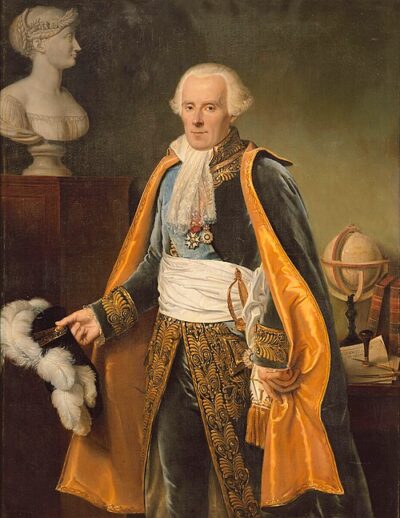
- Pierre-Simon Laplace
- Wikipedias with a page
- 50
Wikidata item Q339444 (wikidata.org/wiki/Q339444), public domain (CC0). Copied 2026-11-17.
What Wikipedia says · copied November 17, 2026 · revision 1352932591
In mathematics and physics, Laplace's equation is a second-order partial differential equation named after Pierre-Simon Laplace, who first studied its properties in 1786. This is often written as
∇2f=0 or Δf=0,
where Δ=∇⋅∇=∇2 is the Laplace operator, ∇⋅ is the divergence operator (also symbolized "div"), ∇ is the gradient operator (also symbolized "grad"), and f(x,y,z) is a twice-differentiable real-valued function. The Laplace operator therefore maps a scalar function to another scalar function.
If the right-hand side is specified as a given function, h(x,y,z), we have
Δf=h
This is called Poisson's equation, a generalization of Laplace's equation. Laplace's equation and Poisson's equation are the simplest examples of elliptic partial differential equations. Laplace's equation is also a special case of the Helmholtz equation.
The general theory of solutions to Laplace's equation is known as potential theory. The twice continuously differentiable solutions of Laplace's equation are the harmonic functions, which are important in multiple branches of physics, notably electrostatics, gravitation, and fluid dynamics. In the study of heat conduction, the Laplace equation is the steady-state heat equation. In general, Laplace's equation describes situations of equilibrium, or those that do not depend explicitly on time.
From the Wikipedia article “Laplace's equation” (en.wikipedia.org/wiki/Laplace's_equation), by its contributors, under CC BY-SA 4.0 (creativecommons.org/licenses/by-sa/4.0/). Copied 2026-11-17; not changed.
Confirmed Two sources agree. Cited One source, and it names where it got it. One source One source, without a reference of its own. Sources disagree The sources disagree. We show the best-supported value and keep theirs below.