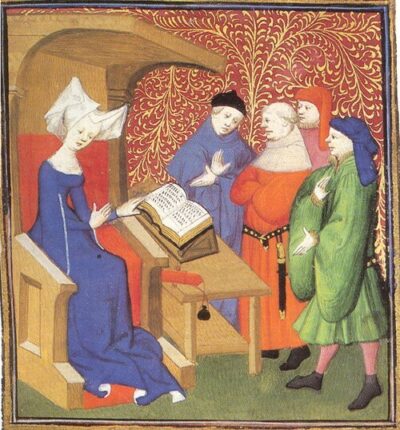
Le livre du chemin de long estude
Le livre du chemin de long estude is a first-person dream allegory by Christine de Pizan; criticizes the moral state of the world and particularly France, lamenting the results of warfare. It came out in 1403.
- Came out
- 1403
- Written by
- Christine de Pizan
- Genre
- allegory
All 5 facts, and where they come from
Facts
5 facts · 0 confirmed by two sources · 0 cited · 5 from one source
Where this comes from
Papalocal keeps its own record. It started from these sources; what each one said is kept here as it was copied, so a change on their side never changes this page by itself. Tap one to read its version.
What Wikidata says · copied November 17, 2026 · revision 2296673629
- Described as
- first-person dream allegory by Christine de Pizan; criticizes the moral state of the world and particularly France, lamenting the results of warfare
- What it is
- literary work
- Written by
- Christine de Pizan
- Genre
- allegory
- Language
- Middle French
- Came out
- 1403
- Wikipedias with a page
- 3
Wikidata item Q1646360 (wikidata.org/wiki/Q1646360), public domain (CC0). Copied 2026-11-17.
What Wikipedia says · copied November 17, 2026 · revision 1367239269
Le livre du chemin de long estude ("The book of the path of long study") is a first-person dream allegory by Christine de Pizan. Composed in 1402–03, it presents a critique of the moral state of the world and particularly France, lamenting the results of warfare.
The poem was dedicated to Charles VI of France; Christine de Pizan presented the first manuscript to John, Duke of Berry. Philip the Bold, Duke of Burgundy, Louis I, Duke of Orléans, and Queen Isabeau of Bavaria also received copies.
From the Wikipedia article “Le livre du chemin de long estude” (en.wikipedia.org/wiki/Le_livre_du_chemin_de_long_estude), by its contributors, under CC BY-SA 4.0 (creativecommons.org/licenses/by-sa/4.0/). Copied 2026-11-17; not changed.
Confirmed Two sources agree. Cited One source, and it names where it got it. One source One source, without a reference of its own. Sources disagree The sources disagree. We show the best-supported value and keep theirs below.