
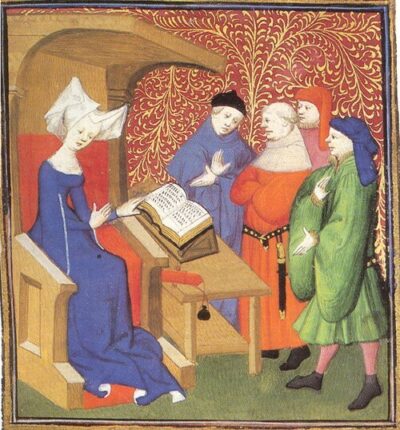
Christine de Pizan
Christine de Pizan was a French poet and author (1364 – c. 1430). Born September 11, 1364, in Venice. Died 1430, in Poissy. Known for The Book of the City of Ladies, Le livre du chemin de long estude and The Treasure of the City of Ladies.
Facts
28 facts · 1 confirmed by two sources · 12 cited · 15 from one source
Where this comes from
Papalocal keeps its own record. It started from these sources; what each one said is kept here as it was copied, so a change on their side never changes this page by itself. Tap one to read its version.
What Wikidata says · copied November 16, 2026 · revision 2568445597
- Described as
- French poet and author (1364 – c. 1430)
- Other names
- Christine de Pisan, Christina de Pisa, Christine De Pisan, Cristina da Pizzano
- Born
- September 11, 1364 · 2 references
- Died
- 1430 · 1 reference
- Born in
- Venice · 7 references
- Died in
- Poissy · 2 references
- Name at birth
- Cristina da Pizzano
- Citizen of
- France · 1 reference
- Occupation
- writer · 2 references; poet · 1 reference; translator · 1 reference; philosopher · 1 reference; women letter writer · 2 references
- Known for
- The Book of the City of Ladies; Le livre du chemin de long estude; The Treasure of the City of Ladies; Complainte amoureuse (I); Complainte amoureuse (II); Les lamentacions sur les maux de la France; Le Ditie de Jehanne d'Arc; Les heures de contemplation de la Passion; L'epistre de la prison de vie humaine; Passion Isabeau
- Field
- poetry · 2 references; literature · 2 references; politics · 1 reference
- Spouse
- Étienne du Castel · 1 reference
- Children
- Jean Castel; Mattheus de Pisano · 1 reference
- Father
- Thomas de Pisan
- Wikipedias with a page
- 80
Wikidata item Q234816 (wikidata.org/wiki/Q234816), public domain (CC0). Copied November 16, 2026.
What Wikipedia says · copied November 16, 2026 · revision 1378886981
Christine de Pizan or Pisan (French: [kʁistin də pizɑ̃] , Middle French: [krisˈtinə də piˈzã]; born Cristina da Pizzano; September 1364 – c. 1430), was a Venetian-born French court writer for King Charles VI of France and several French royal dukes, in both prose and poetry. She wrote in French, having been raised in France to parents who came from Bologna. Her father was invited to the French court in 1368, when Christine was only four years old, to serve as a doctor and astrologer. He insisted that his daughter learn philosophy, Latin, Italian, French, history, literature, and science, which was very unusual for the time.
Christine became a court writer in medieval France after the death of her husband. Her patrons included dukes Louis I of Orleans, Philip the Bold of Burgundy, and his son John the Fearless. Considered to be some of the earliest feminist writings, her work includes novels, poetry, and biography, and she also penned literary, historical, philosophical, political, and religious reviews and analyses. Her best known works are The Book of the City of Ladies and The Treasure of the City of Ladies, both prose works written when she worked for John the Fearless of Burgundy. Her books of advice to princesses, princes, and knights remained in print until the sixteenth century.
- Born, in its opening lines
- September 1364
From the Wikipedia article “Christine de Pizan” (en.wikipedia.org/wiki/Christine_de_Pizan), by its contributors, under CC BY-SA 4.0 (creativecommons.org/licenses/by-sa/4.0/). Copied November 16, 2026; not changed.
Confirmed Two sources agree. Cited One source, and it names where it got it. One source One source, without a reference of its own. Sources disagree The sources disagree. We show the best-supported value and keep theirs below.
