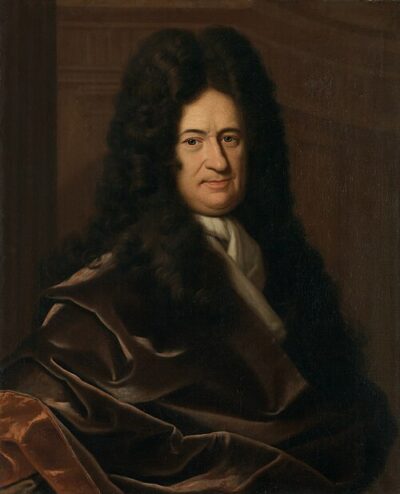
Leibniz's notation
Leibniz's notation is a mathematical notation.
All 2 facts, and where they come from
Facts
2 facts · 0 confirmed by two sources · 0 cited · 2 from one source
Where this comes from
Papalocal keeps its own record. It started from these sources; what each one said is kept here as it was copied, so a change on their side never changes this page by itself. Tap one to read its version.
What Wikidata says · copied November 17, 2026 · revision 2553388978
- Described as
- mathematical notation
- What it is
- notation for differentiation
- Named after
- Gottfried Wilhelm Leibniz
- Wikipedias with a page
- 20
Wikidata item Q1069516 (wikidata.org/wiki/Q1069516), public domain (CC0). Copied 2026-11-17.
What Wikipedia says · copied November 17, 2026 · revision 1383383392
In calculus, Leibniz's notation, named in honor of the 17th-century German philosopher and mathematician Gottfried Wilhelm Leibniz, uses the symbols dx and dy to represent infinitely small (or infinitesimal) increments of x and y, respectively, just as Δx and Δy represent finite increments of x and y, respectively.
Consider y as a function of a variable x, or y = f(x). If this is the case, then the derivative of y with respect to x, which later came to be viewed as the limitlimΔx→0ΔyΔx=limΔx→0f(x+Δx)−f(x)Δx,
was, according to Leibniz, the quotient of an infinitesimal increment of y by an infinitesimal increment of x, ordydx=f′(x),
where the right hand side is Joseph-Louis Lagrange's notation for the derivative of f at x. The infinitesimal increments are called differentials. Related to this is the integral in which the infinitesimal increments are summed (e.g. to compute lengths, areas and volumes as sums of tiny pieces), for which Leibniz also supplied a closely related notation involving the same differentials, a notation whose efficiency proved decisive in the development of continental European mathematics.
Leibniz's concept of infinitesimals, long considered to be too imprecise to be used as a foundation of calculus, was eventually replaced by rigorous concepts developed by Weierstrass and others in the 19th century. Consequently, Leibniz's quotient notation was re-interpreted to stand for the limit of the modern definition. However, in many instances, the symbol did seem to act as an actual quotient would and its usefulness kept it popular even in the face of several competing notations. Several different formalisms were developed in the 20th century that can give rigorous meaning to notions of infinitesimals and infinitesimal displacements, including nonstandard analysis, tangent space, O notation and others.
The derivatives and integrals of calculus can be packaged into the modern theory of differential forms, in which the derivative is genuinely a ratio of two differentials, and the integral likewise behaves in exact accordance with Leibniz notation. However, this requires that derivative and integral first be defined by other means, and as such expresses the self-consistency and computational efficacy of the Leibniz notation rather than giving it a new foundation.
From the Wikipedia article “Leibniz's notation” (en.wikipedia.org/wiki/Leibniz's_notation), by its contributors, under CC BY-SA 4.0 (creativecommons.org/licenses/by-sa/4.0/). Copied 2026-11-17; not changed.
Confirmed Two sources agree. Cited One source, and it names where it got it. One source One source, without a reference of its own. Sources disagree The sources disagree. We show the best-supported value and keep theirs below.