
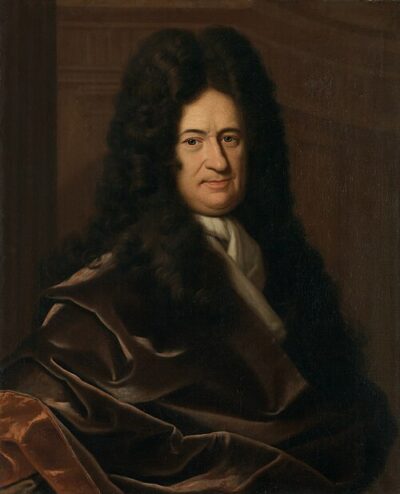
Gottfried Wilhelm Leibniz
Gottfried Wilhelm Leibniz was a German mathematician and philosopher. Born June 21, 1646, in Leipzig. Died November 14, 1716, in Hanover. Positions held include Geheimrat, court counsel (1678–) and Aulic Council (1713–). Known for Discourse on Metaphysics, Théodicée and integral calculus. Educated at University of Altdorf and Leipzig University. Awards include Fellow of the Royal Society.
Facts
43 facts · 1 confirmed by two sources · 18 cited · 23 from one source · 1 where the sources disagree
What’s different
- Born: we show June 21, 1646 (Sources disagree). Wikipedia says July 1, 1646
Where this comes from
Papalocal keeps its own record. It started from these sources; what each one said is kept here as it was copied, so a change on their side never changes this page by itself. Tap one to read its version.
What Wikidata says · copied November 16, 2026 · revision 2566065008
- Described as
- German mathematician and philosopher (1646–1716)
- Other names
- Gottfried Leibniz, Leibnitz, Freiherr Gottfried Wilhelm von Leibniz, Gottfried Wilhelm, Gottfried Wilhelm von Leibniz, Leibniz
- Born
- June 21, 1646 · 12 references
- Died
- November 14, 1716 · 15 references
- Born in
- Leipzig · 3 references
- Died in
- Hanover · 5 references
- Buried in
- Neustädter Hof- und Stadtkirche St. Johannis
- Citizen of
- Electorate of Saxony
- Occupation
- mathematician · 6 references; jurist · 1 reference; physicist · 4 references; philosopher · 4 references; diplomat; historian · 1 reference; librarian · 5 references; musicologist
- Positions held
- Geheimrat; court counsel (1678–); Aulic Council (1713–)
- Worked for
- Leipzig University · 1 reference
- Education
- University of Altdorf (1666–1667) · 1 reference; Leipzig University (1661–1666) · 1 reference; University of Jena (1663) · 1 reference; Alte Nikolaischule (Leipzig) (1653–1661); Thomasschule zu Leipzig
- Member of
- Royal Prussian Academy of Sciences (1700–); Royal Society of London (1673–) · 1 reference; French Academy of Sciences (1699–) · 2 references
- Known for
- Discourse on Metaphysics; Théodicée; integral calculus; Stepped Reckoner; Monadology; Leibniz's notation; calculus ratiocinator; New Essays on Human Understanding; Nova Methodus pro Maximis et Minimis
- Awards
- Fellow of the Royal Society (1673) · 1 reference
- Field
- mathematical analysis; Christian apologetics
- Father
- Friedrich Leibnütz · 1 reference
- Mother
- Catharina Schmuck · 1 reference
- Siblings
- Johann Friedrich Leibnitz · 1 reference; Anna Catharina Löffler · 1 reference
- Religion
- Lutheranism
- Wikipedias with a page
- 207
Wikidata item Q9047 (wikidata.org/wiki/Q9047), public domain (CC0). Copied November 16, 2026.
What Wikipedia says · copied November 16, 2026 · revision 1385775815
Gottfried Wilhelm Leibniz (or Leibnitz; 1 July 1646 [O.S. 21 June] – 14 November 1716) was a German polymath active as a mathematician, philosopher, scientist, engineer, inventor, historian and diplomat. Alongside Isaac Newton, he is widely credited with the invention of calculus. He is also credited with making foundational contributions to other areas of mathematics, such as binary arithmetic and statistics.
Leibniz has been called the "last true genius" due to his vast expertise across fields, which became a rarity after his lifetime with the coming of the Industrial Revolution and the spread of specialized labour. He is a prominent figure in both the history of philosophy and the history of mathematics. He wrote works on philosophy, theology, ethics, politics, law, history, philology, games, music, economics and other studies. Leibniz also made major contributions to physics and technology, and anticipated notions that surfaced much later in probability theory, biology, medicine, geology, psychology, linguistics and computer science.
Leibniz contributed to the field of library science, developing a cataloguing system (at the Herzog August Library in Wolfenbüttel, Germany) that came to serve as a model for many of Europe's largest libraries. His contributions to a wide range of subjects were scattered in various learned journals, in tens of thousands of letters and in unpublished manuscripts. He wrote in several languages, primarily in Latin, French and German.
As a philosopher, he was a leading representative of 17th-century rationalism and idealism. As a mathematician, his major achievement was the development of differential and integral calculus, independently of Newton's developments. Although Newton first developed his theory earlier in 1666, and which had been in circulation among mathematicians since 1668, Leibniz's notation has been favoured as the conventional and more exact expression of calculus. In addition to his work on calculus, he is credited with devising the modern binary number system which is the basis of modern communications and digital computing (though the English astronomer Thomas Harriot had devised the same system decades before). He envisioned the field of combinatorial topology as early as 1679, and helped initiate the field of fractional calculus.
In the 20th century, Leibniz's notions of the law of continuity and the transcendental law of homogeneity found a consistent mathematical formulation by means of non-standard analysis. He was also a pioneer in the field of mechanical calculators. While working on adding automatic multiplication and division to Pascal's calculator, he was the first to describe a pinwheel calculator in 1685 and invented the Leibniz wheel, later used in the arithmometer, the first mass-produced mechanical calculator.
In philosophy and theology, Leibniz is most noted for his optimism, i.e. his conclusion that our world is, in a qualified sense, the best possible world that God could have created, a view sometimes lampooned by other thinkers, such as Voltaire in his satirical novella Candide. Leibniz, along with René Descartes and Baruch Spinoza, was one of the three influential early modern rationalists. His philosophy also assimilates elements of the scholastic tradition, notably the assumption that some substantive knowledge of reality can be achieved by reasoning from first principles or prior definitions. The work of Leibniz anticipated modern logic and still influences contemporary analytic philosophy, such as its adopted use of the term possible world to define modal notions.
- Born, in its opening lines
- July 1, 1646
- Died, in its opening lines
- November 14, 1716
From the Wikipedia article “Gottfried Wilhelm Leibniz” (en.wikipedia.org/wiki/Gottfried_Wilhelm_Leibniz), by its contributors, under CC BY-SA 4.0 (creativecommons.org/licenses/by-sa/4.0/). Copied November 16, 2026; not changed.
Confirmed Two sources agree. Cited One source, and it names where it got it. One source One source, without a reference of its own. Sources disagree The sources disagree. We show the best-supported value and keep theirs below.
