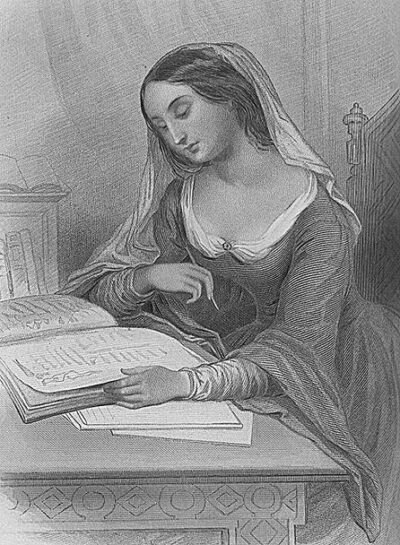
Letters of Abelard and Heloise
Letters of Abelard and Heloise is a 12th century love correspondence. It was written by Peter Abelard and Héloïse d’Argenteuil.
- Published
- 12th century
- Written by
- Peter Abelard
- Genre
- correspondence
All 6 facts, and where they come from
Facts
6 facts · 0 confirmed by two sources · 0 cited · 6 from one source
Where this comes from
Papalocal keeps its own record. It started from these sources; what each one said is kept here as it was copied, so a change on their side never changes this page by itself. Tap one to read its version.
What Wikidata says · copied November 17, 2026 · revision 2554483015
- Described as
- 12th century love correspondence
- Other names
- Letters of Abelard and Eloisa
- What it is
- literary work
- Written by
- Peter Abelard; Héloïse d’Argenteuil
- Genre
- correspondence
- Published
- 12th century
- Language
- medieval Latin
- Wikipedias with a page
- 4
Wikidata item Q120629836 (wikidata.org/wiki/Q120629836), public domain (CC0). Copied 2026-11-17.
What Wikipedia says · copied November 17, 2026 · revision 1384238830
The Letters of Abelard and Heloise (Latin: Epistolae Abaelardi et Heloisae) are two series of passionate and intellectual correspondence apparently written in Latin during the 12th century. The purported authors, Peter Abelard, a prominent theologian, and his pupil, Heloise, a gifted young woman later renowned as an abbess, exchanged these letters following their ill-fated love affair and subsequent monastic lives.
The letters reveal the personal and intellectual relationship between Abelard and Heloise, and provide an intimate glimpse into the societal context of 12th-century Europe. They've played a significant role in the development of Western epistolary literature, attracting attention from historians, literary scholars, and general readers alike. The Letters of Abelard and Heloise also serve as primary source documents on questions of medieval gender roles, love, and monastic life.
Donald Ostrowski grouped the two series as follows:AH-1: The first set of 15 letters, found in Latin and translated to French by author Jean de Meun in the 1280s.
9 letters attributed to Abelard, 4 of which were addressed to Heloise. The first of these four is the Historia Calamitatum.
6 letters attributed to Heloise, 3 of which were addressed to Abelard, and 1 to Peter the Venerable.
AH-2: The second set of 113 anonymous letters, called Epistolae Duorum Amantium, transcribed in the late 15th century by the monk Johannes de Vepria (c. 1445–c. 1515), prior of Clairvaux Abbey (1480–1499).
These 113 letters are anonymous, describing interactions between a male teacher and a female student, whose relationship went beyond the academic.
From the Wikipedia article “Letters of Abelard and Heloise” (en.wikipedia.org/wiki/Letters_of_Abelard_and_Heloise), by its contributors, under CC BY-SA 4.0 (creativecommons.org/licenses/by-sa/4.0/). Copied 2026-11-17; not changed.
Confirmed Two sources agree. Cited One source, and it names where it got it. One source One source, without a reference of its own. Sources disagree The sources disagree. We show the best-supported value and keep theirs below.