Letters on the English
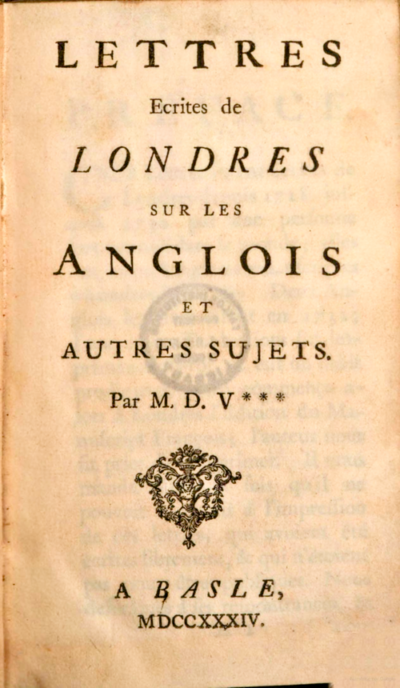
Letters on the English is a 1734 essay by Voltaire.
All 6 facts, and where they come from
Facts
6 facts · 0 confirmed by two sources · 0 cited · 6 from one source
Where this comes from
Papalocal keeps its own record. It started from these sources; what each one said is kept here as it was copied, so a change on their side never changes this page by itself. Tap one to read its version.
What Wikidata says · copied November 17, 2026 · revision 2569786907
- Described as
- 1734 essay by Voltaire
- Other names
- Letters concerning the English Nation
- What it is
- literary work
- Written by
- Voltaire
- Genre
- essay
- Published
- 1734
- Language
- French
- Country of origin
- France · 1 reference
- Wikipedias with a page
- 14
Wikidata item Q2551373 (wikidata.org/wiki/Q2551373), public domain (CC0). Copied 2026-11-17.
What Wikipedia says · copied November 17, 2026 · revision 1384798210
Letters on the English (or Letters Concerning the English Nation; French: Lettres philosophiques) are a series of essays written by Voltaire based on his experiences living in Great Britain between 1726 and 1729. The book was published first in English in 1733 and then in French the following year, where it was seen as an attack on the French system of government and was rapidly suppressed.
A revised edition appeared in English in 1778 as Lettres philosophiques sur les Anglais (Philosophical Letters on the English). Most modern English editions are based on the one from 1734 and typically use the title Philosophical Letters, a direct translation of that version's title.
In some ways, the book can be compared with Democracy in America by Alexis de Tocqueville, in how it flatteringly explains a nation to itself from the perspective of an outsider, as Voltaire's depictions of aspects of English culture, society and government are often given favourable treatment in comparison to their French equivalents.
From the Wikipedia article “Letters on the English” (en.wikipedia.org/wiki/Letters_on_the_English), by its contributors, under CC BY-SA 4.0 (creativecommons.org/licenses/by-sa/4.0/). Copied 2026-11-17; not changed.
Confirmed Two sources agree. Cited One source, and it names where it got it. One source One source, without a reference of its own. Sources disagree The sources disagree. We show the best-supported value and keep theirs below.
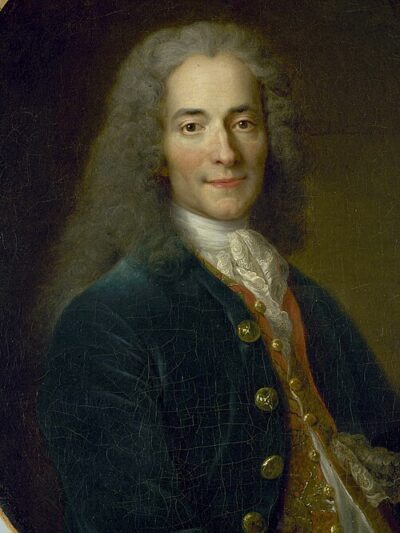
Picture: Voltaire, via Wikimedia Commons · Public domain