
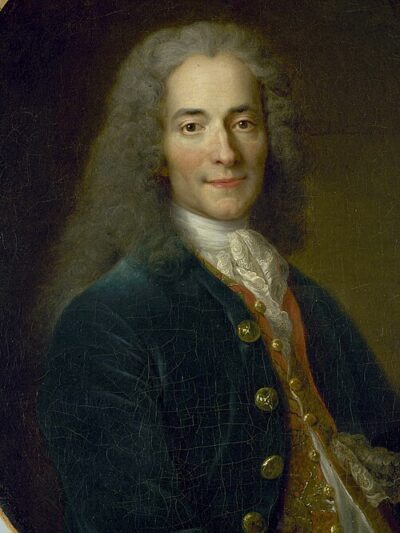
Voltaire
Voltaire was a French writer, historian and philosopher. Born November 21, 1694, in Paris. Died May 30, 1778, in Paris. Positions held include historiographer of France (1744–1750) and Member of the Académie française (1746–1778). Known for Candide, Zadig or Destiny and Zaïre. Educated at Lycée Louis-le-Grand. Awards include Pour le Mérite for Sciences and Arts order and Fellow of the Royal Society.
Facts
42 facts · 2 confirmed by two sources · 14 cited · 26 from one source
Where this comes from
Papalocal keeps its own record. It started from these sources; what each one said is kept here as it was copied, so a change on their side never changes this page by itself. Tap one to read its version.
What Wikidata says · copied November 16, 2026 · revision 2568004321
- Described as
- French writer, historian and philosopher (1694–1778)
- Other names
- François Marie Arouet, François-Marie Arouet, Benedictina
- Born
- November 21, 1694 · 4 references
- Died
- May 30, 1778 · 6 references
- Born in
- Paris · 4 references
- Died in
- Paris · 4 references
- Buried in
- Panthéon (1791–); Abbaye de Sellières (1778–1791) · 1 reference
- Name at birth
- François-Marie Arouet
- Citizen of
- Kingdom of France
- Occupation
- philosopher · 3 references; poet · 2 references; historian · 2 references; essayist; playwright; autobiographer; diarist; poet lawyer
- Positions held
- historiographer of France (1744–1750); Member of the Académie française (1746–1778) · 1 reference
- Education
- Lycée Louis-le-Grand
- Member of
- Royal Society of London (1743–) · 1 reference; Académie Française (1746–); Royal Prussian Academy of Sciences (1746–) · 1 reference; Russian Academy of Sciences · 1 reference; Royal Swedish Academy of Letters, History and Antiquities (1774–) · 1 reference; Freemasonry (1778–) · 1 reference; Accademia della Crusca
- Known for
- Candide; Zadig or Destiny; Zaïre; Letters on the English; Dictionnaire philosophique; The Huron; or, Pupil of Nature; Mahomet; Correspondence of Voltaire; Lettres du roi de Prusse et de M. de Voltaire
- Awards
- Pour le Mérite for Sciences and Arts order; Fellow of the Royal Society (1743) · 1 reference
- Field
- philosophy
- Father
- François d'Arouet
- Mother
- Marguerite d'Aumard
- Siblings
- Marguerite Catherine Arouet · 1 reference
- Religion
- atheism
- Wikipedias with a page
- 257
Wikidata item Q9068 (wikidata.org/wiki/Q9068), public domain (CC0). Copied November 16, 2026.
What Wikipedia says · copied November 16, 2026 · revision 1384498966
François-Marie Arouet (French: [fʁɑ̃swa maʁi aʁwɛ]; 21 November 1694 – 30 May 1778), known by his pen name Voltaire (, US also ; French: [vɔltɛːʁ]), was a French Enlightenment writer, philosopher (philosophe), satirist, and historian. Famous for his wit and his Criticisms of the Catholic Church and slavery, Voltaire was an advocate of freedom of speech, freedom of religion, and separation of church and state.
Voltaire produced works in almost every literary form, including plays, poems, novels, essays, histories, and scientific expositions. He wrote more than 20,000 letters and 2,000 books and pamphlets. Voltaire was one of the first authors to become renowned and commercially successful internationally. He was an outspoken advocate of civil liberties and was at constant risk from the strict censorship laws of the Catholic French monarchy. His polemics satirized intolerance and religious dogma, as well as the French institutions of his day. His best-known work and magnum opus, Candide, is a novella that comments on, criticizes, and ridicules many events, thinkers and philosophies of his time, most notably Gottfried Leibniz and his belief that our world is of necessity the "best of all possible worlds".
- Born, in its opening lines
- November 21, 1694
- Died, in its opening lines
- May 30, 1778
From the Wikipedia article “Voltaire” (en.wikipedia.org/wiki/Voltaire), by its contributors, under CC BY-SA 4.0 (creativecommons.org/licenses/by-sa/4.0/). Copied November 16, 2026; not changed.
Confirmed Two sources agree. Cited One source, and it names where it got it. One source One source, without a reference of its own. Sources disagree The sources disagree. We show the best-supported value and keep theirs below.
