Liepāja Gymnasium
Liepāja Gymnasium is a defunct Latvian secondary school. It was founded in 1885.
- Country
- Russian Empire
- Founded
- 1885
- What it is
- gymnasium
All 5 facts, and where they come from
Facts
5 facts · 0 confirmed by two sources · 0 cited · 5 from one source
Where this comes from
Papalocal keeps its own record. It started from these sources; what each one said is kept here as it was copied, so a change on their side never changes this page by itself. Tap one to read its version.
What Wikidata says · copied November 17, 2026 · revision 2565838275
- Described as
- defunct Latvian secondary school
- Other names
- Libau Gymnasium, Liepāja Nicholas Gymnasium
- What it is
- gymnasium
- Founded
- 1885 · 1 reference
- Ended
- 1915
- Headquarters
- Liepāja
- Country
- Russian Empire
- Wikipedias with a page
- 8
Wikidata item Q5619796 (wikidata.org/wiki/Q5619796), public domain (CC0). Copied 2026-11-17.
What Wikipedia says · copied November 17, 2026 · revision 1314224499
Liepāja Nicolai Gymnasium was a six-year (later seven) gymnasium (high school) in Liepāja (Libau), Courland Governorate, Russian Empire.
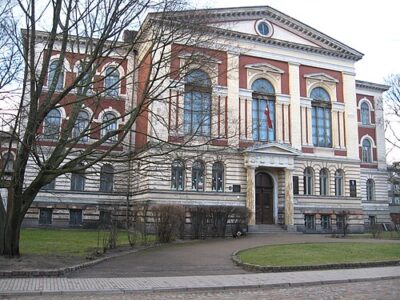
It was established in 1865 on the basis of a school that traced its roots to 1848. The school was named in honor of Nicholas Alexandrovich, Tsesarevich of Russia. The school building was constructed in 1883–1885 by architect Paul Max Bertschy. The school was diverse in students' religious and ethnic background. For example, in 1884, out of 398 pupils, 161 were Evangelical Lutherans (41.2%), 130 Jews (33.3%), 76 Catholics (19.4%) and 22 Eastern Orthodoxs (5.6%). The curriculum devoted substantial attention to the Latin and Greek languages. The language of instruction was switched from German to Russian in 1887.
The school continued to function until its evacuation to Petrograd during World War I (1915).
From the Wikipedia article “Liepāja Gymnasium” (en.wikipedia.org/wiki/Liepāja_Gymnasium), by its contributors, under CC BY-SA 4.0 (creativecommons.org/licenses/by-sa/4.0/). Copied 2026-11-17; not changed.
Confirmed Two sources agree. Cited One source, and it names where it got it. One source One source, without a reference of its own. Sources disagree The sources disagree. We show the best-supported value and keep theirs below.
Picture: Wellstar69, via Wikimedia Commons · CC BY-SA 4.0