Lorentz force
Lorentz force is a force exerted on a charge in electromagnetic field.
All 2 facts, and where they come from
Facts
2 facts · 0 confirmed by two sources · 0 cited · 2 from one source
Where this comes from
Papalocal keeps its own record. It started from these sources; what each one said is kept here as it was copied, so a change on their side never changes this page by itself. Tap one to read its version.
What Wikidata says · copied November 17, 2026 · revision 2546897116
- Described as
- force exerted on a charge in electromagnetic field
- Other names
- electromagnetic force, Coulomb-Lorentz force, Lorentz's law
- What it is
- physical theory
- Named after
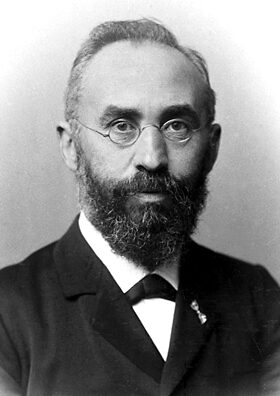
- Hendrik Lorentz
- Wikipedias with a page
- 75
Wikidata item Q172137 (wikidata.org/wiki/Q172137), public domain (CC0). Copied 2026-11-17.
What Wikipedia says · copied November 17, 2026 · revision 1382686055
In electromagnetism, the Lorentz force is the force exerted on a charged particle by electric and magnetic fields. It determines how charged particles move in electromagnetic environments and underlies many physical phenomena, from the operation of electric motors and particle accelerators to the behavior of plasmas.
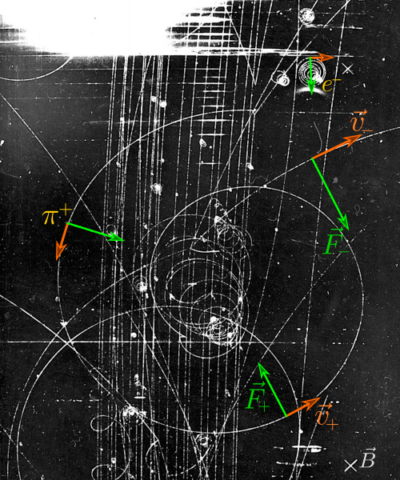
The Lorentz force has two components. The electric force acts in the direction of the electric field for positive charges and opposite to it for negative charges, tending to accelerate the particle in a straight line. The magnetic force is perpendicular to both the particle's velocity and the magnetic field, and it causes the particle to move along a curved trajectory, often circular or helical in form, depending on the directions of the fields.
Variations on the force law describe the magnetic force on a current-carrying wire (sometimes called Laplace force), and the electromotive force in a wire loop moving through a magnetic field, as described by Faraday's law of induction.
Together with Maxwell's equations, which describe how electric and magnetic fields are generated by charges and currents, the Lorentz force law forms the foundation of classical electrodynamics. While the law remains valid in special relativity, it breaks down at small scales where quantum effects become important. In particular, the intrinsic spin of particles gives rise to additional interactions with electromagnetic fields that are not accounted for by the Lorentz force.
Historians suggest that the law is implicit in a paper by James Clerk Maxwell, published in 1865. Hendrik Lorentz arrived at a complete derivation in 1895, identifying the contribution of the electric force a few years after Oliver Heaviside correctly identified the contribution of the magnetic force.
From the Wikipedia article “Lorentz force” (en.wikipedia.org/wiki/Lorentz_force), by its contributors, under CC BY-SA 4.0 (creativecommons.org/licenses/by-sa/4.0/). Copied 2026-11-17; not changed.
Confirmed Two sources agree. Cited One source, and it names where it got it. One source One source, without a reference of its own. Sources disagree The sources disagree. We show the best-supported value and keep theirs below.
Picture: Ponor, via Wikimedia Commons · CC BY-SA 4.0