Lorentz transformation
Lorentz transformation is a space-time coordinate transformation that conserves the form of Maxwell’s equations.
All 3 facts, and where they come from
Facts
3 facts · 0 confirmed by two sources · 0 cited · 3 from one source
Where this comes from
Papalocal keeps its own record. It started from these sources; what each one said is kept here as it was copied, so a change on their side never changes this page by itself. Tap one to read its version.
What Wikidata says · copied November 17, 2026 · revision 2515853901
- Described as
- space-time coordinate transformation that conserves the form of Maxwell’s equations
- What it is
- geometric transformation; mathematical concept
- Named after
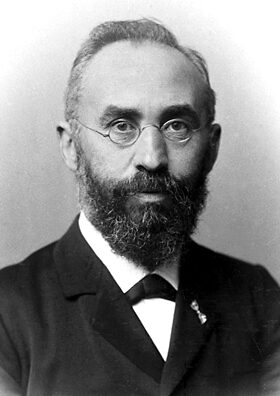
- Hendrik Lorentz
- Wikipedias with a page
- 61
Wikidata item Q217255 (wikidata.org/wiki/Q217255), public domain (CC0). Copied 2026-11-17.
What Wikipedia says · copied November 17, 2026 · revision 1385400869
In physics, the Lorentz transformations are a six-parameter family of linear transformations from a coordinate frame in spacetime to another frame that moves at a constant velocity relative to the former. The respective inverse transformation is then parameterized by the negative of this velocity. The transformations are named after the Dutch physicist Hendrik Lorentz.
The most common form of the transformation, parametrized by the real constant v, representing a velocity confined to the x-direction, is expressed as
t′=γ(t−vxc2)x′=γ(x−vt)y′=yz′=z
where (t, x, y, z) and (t′, x′, y′, z′) are the coordinates of an event in two frames with the spatial origins coinciding at t = t′ = 0, where the primed frame is seen from the unprimed frame as moving with speed v along the x-axis, where c is the speed of light, and
γ=11−v2/c2
is the Lorentz factor. When speed v is much smaller than c, the Lorentz factor is negligibly different from 1, but as v approaches c, γ grows without bound. The value of v must be smaller than c for the transformation to produce functional solutions.
Expressing the speed as a fraction of the speed of light, β=v/c, an equivalent form of the transformation is
ct′=γ(ct−βx)x′=γ(x−βct)y′=yz′=z.
Frames of reference can be divided into two groups: inertial (relative motion with constant velocity) and non-inertial (accelerating, moving in curved paths, rotational motion with constant angular velocity, etc.). The term "Lorentz transformations" only refers to transformations between inertial frames, usually in the context of special relativity.
In each reference frame, an observer can use a local coordinate system (usually Cartesian coordinates in this context) to measure lengths, and a clock to measure time intervals. An event is something that happens at a point in space at an instant of time, or more formally a point in spacetime. The transformations connect the space and time coordinates of an event as measured by an observer in each frame.
They supersede the Galilean transformation of Newtonian physics, which assumes an absolute space and time (see Galilean relativity). The Galilean transformation is a good approximation only at relative speeds much less than the speed of light. Lorentz transformations have a number of unintuitive features that do not appear in Galilean transformations. For example, they reflect the fact that observers moving at different velocities may measure different distances, elapsed times, and even different orderings of events, but always such that the speed of light is the same in all inertial reference frames. The invariance of light speed is one of the postulates of special relativity.
Historically, the transformations were the result of attempts by Lorentz and others to explain how the speed of light was observed to be independent of the reference frame, and to understand the symmetries of the laws of electromagnetism. The transformations later became a cornerstone for special relativity.
The Lorentz transformation is a linear transformation. It may include a rotation of space; a rotation-free Lorentz transformation is called a Lorentz boost. In Minkowski space—the mathematical model of spacetime in special relativity—the Lorentz transformations preserve the spacetime interval between any two events. They describe only the transformations in which the spacetime event at the origin is left fixed. They can be considered as a hyperbolic rotation of Minkowski space. The more general set of transformations that also includes translations is known as the Poincaré group.
From the Wikipedia article “Lorentz transformation” (en.wikipedia.org/wiki/Lorentz_transformation), by its contributors, under CC BY-SA 4.0 (creativecommons.org/licenses/by-sa/4.0/). Copied 2026-11-17; not changed.
Confirmed Two sources agree. Cited One source, and it names where it got it. One source One source, without a reference of its own. Sources disagree The sources disagree. We show the best-supported value and keep theirs below.
Picture: Wikimedia Commons: Lorentz transforms 3.svg · See Commons file page