Luceafărul
Luceafărul is a literary work. It came out in 1883. It was written by Mihai Eminescu.
- Published
- 1883
- Written by
- Mihai Eminescu
- Genre
- narrative poetry
- Country of origin
- Romania
All 8 facts, and where they come from
Facts
8 facts · 0 confirmed by two sources · 0 cited · 8 from one source
Where this comes from
Papalocal keeps its own record. It started from these sources; what each one said is kept here as it was copied, so a change on their side never changes this page by itself. Tap one to read its version.
What Wikidata says · copied November 17, 2026 · revision 2529143370
- Described as
- poem
- What it is
- literary work
- Written by
- Mihai Eminescu
- Genre
- narrative poetry
- Published
- 1883
- Language
- Romanian
- Country of origin
- Romania · 1 reference
- Named after
- Lucifer; Lucifer
- Wikipedias with a page
- 16
Wikidata item Q1586176 (wikidata.org/wiki/Q1586176), public domain (CC0). Copied 2026-11-17.
What Wikipedia says · copied November 17, 2026 · revision 1382509155
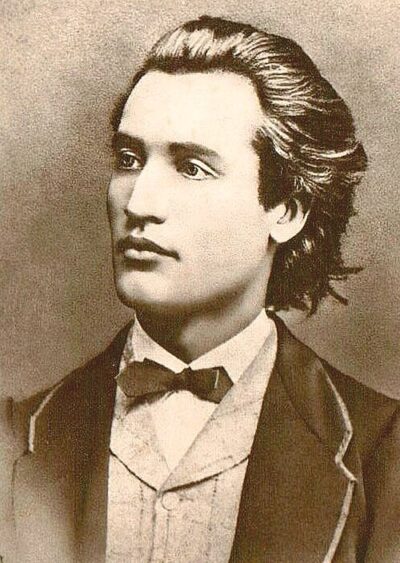
Luceafărul (originally spelled Luceafĕrul according to obsolete norms; pronunciation: [luˈtʃe̯afərul]; variously rendered as "The Morning Star", "The Evening Star", "The Vesper", "The Daystar", or "Lucifer") is a narrative poem by Romanian author Mihai Eminescu. It was first published in 1883, out of Vienna, by Romanian expatriates in Austria-Hungary. It is generally considered Eminescu's masterpiece, one of the greatest accomplishments in Romanian literature, and one of the last milestones in Europe's romantic poetry. One in a family or "constellation" of poems, it took Eminescu ten years to conceive, its final shape being partly edited by the philosopher Titu Maiorescu. During this creative process, Eminescu distilled Romanian folklore, Romantic themes, and various staples of Indo-European myth, arriving from a versified fairy tale to a mythopoeia, a self-reflection on his condition as a genius, and an illustration of his philosophy of love.
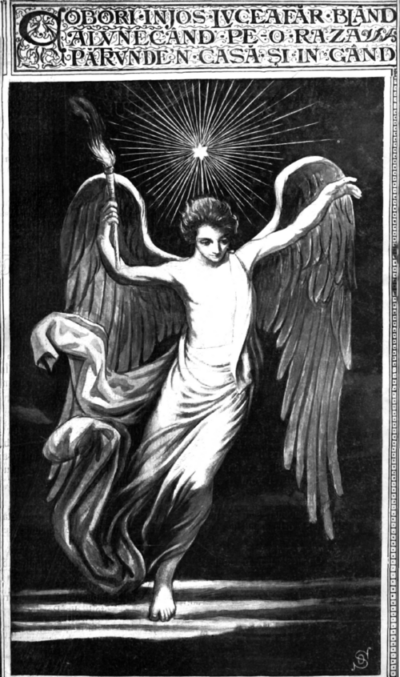
The eponymous celestial being, also referred to as "Hyperion", is widely identified as Eminescu's alter ego; he combines elements of fallen angels, daimons, incubi, but is neither mischievous nor purposefully seductive. His daily mission on the firmament is interrupted by the calls of Princess Cătălina, who asks for him to "glide down" and become her mate. He is persuaded by her to relinquish his immortality, which would require approval from a third protagonist, the Demiurge. The Morning Star seeks the Demiurge at the edge of the Universe, but only receives a revelation of mankind's irrelevancy. In his brief absence, the Princess is seduced by a fellow mortal. As he returns to his place in the sky, Hyperion understands that the Demiurge was right.
Luceafărul enjoys fame not just as a poetic masterpiece, but also as one of the last works completed and read publicly by Eminescu before his debilitating mental illness and hospitalization. It has endured in cultural memory as both the object of critical scrutiny and a strong favorite of the public. Its translators into various languages include figures such as Rafael Alberti, Günther Deicke, Zoltán Franyó, Mite Kremnitz, Omar Lara, Leon Levițchi, Mate Maras, Corneliu M. Popescu, David Samoylov, Immanuel Weissglas, Todur Zanet, and Vilém Závada. The poem left a distinct legacy in literary works by Mircea Eliade, Emil Loteanu, Alexandru Vlahuță, and, possibly, Ingeborg Bachmann. It has also inspired composers Nicolae Bretan and Eugen Doga, as well as various visual artists.
From the Wikipedia article “Luceafărul (poem)” (en.wikipedia.org/wiki/Luceafărul_(poem)), by its contributors, under CC BY-SA 4.0 (creativecommons.org/licenses/by-sa/4.0/). Copied 2026-11-17; not changed.
Confirmed Two sources agree. Cited One source, and it names where it got it. One source One source, without a reference of its own. Sources disagree The sources disagree. We show the best-supported value and keep theirs below.
Picture: Octavian Smigelschi, via Wikimedia Commons · Public domain