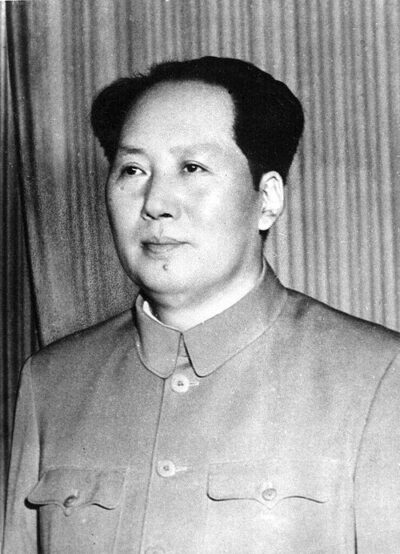
Maoism
Maoism is a variety of Marxism–Leninism and Tridemism developed by Mao Zedong.
- Created by
- Mao Zedong
All 3 facts, and where they come from
Facts
3 facts · 0 confirmed by two sources · 0 cited · 3 from one source
Where this comes from
Papalocal keeps its own record. It started from these sources; what each one said is kept here as it was copied, so a change on their side never changes this page by itself. Tap one to read its version.
What Wikidata says · copied November 17, 2026 · revision 2553947274
- Described as
- variety of Marxism–Leninism and Tridemism developed by Mao Zedong
- Other names
- Mao Zedong Thought, Marxism–Leninism–Mao Zedong Thought, Maoists
- What it is
- political ideology
- Created by
- Mao Zedong
- Named after
- Mao Zedong
- Wikipedias with a page
- 79
Wikidata item Q167651 (wikidata.org/wiki/Q167651), public domain (CC0). Copied 2026-11-17.
What Wikipedia says · copied November 17, 2026 · revision 1385843894
Maoism, officially Mao Zedong Thought, is a variety of Marxism–Leninism that Mao Zedong developed while trying to realise a socialist revolution in the agricultural, pre-industrial society of the Republic of China and later the People's Republic of China. A difference between Maoism and traditional Marxism–Leninism is that a united front of progressive forces in class society would lead the revolutionary vanguard in pre-industrial societies rather than communist revolutionaries alone. This theory, in which revolutionary praxis is primary and ideological orthodoxy is secondary, purports to represent urban Marxism–Leninism adapted to pre-industrial China. Later theoreticians expanded on the idea that Mao had adapted Marxism–Leninism to Chinese conditions, arguing that he had in fact updated it fundamentally and that Maoism could be applied universally throughout the world. This ideology is often referred to as Marxism–Leninism–Maoism to distinguish it from the original ideas of Mao.
From the 1950s until the reform and opening up of Deng Xiaoping in the late 1970s, Maoism was the political and military ideology of the Chinese Communist Party and Maoist revolutionary movements worldwide. After the Sino-Soviet split of the 1960s, the Chinese Communist Party and the Communist Party of the Soviet Union each claimed to be the sole heir and successor to Joseph Stalin concerning the correct interpretation of Marxism–Leninism and the ideological leader of world communism.
The English term "Maoism" was coined in 1951 by Benjamin I. Schwartz, who sought to describe Mao's pragmatic strategy of revolution which was based on his adaptation of elements of Marxism-Leninism, particularly his belief that China should be ruled by a disciplined and hierarchical Communist Party, with the support of a mobilized peasant mass base.
From the Wikipedia article “Maoism” (en.wikipedia.org/wiki/Maoism), by its contributors, under CC BY-SA 4.0 (creativecommons.org/licenses/by-sa/4.0/). Copied 2026-11-17; not changed.
Confirmed Two sources agree. Cited One source, and it names where it got it. One source One source, without a reference of its own. Sources disagree The sources disagree. We show the best-supported value and keep theirs below.
Picture: Wikimedia Commons: Maoism.png · See Commons file page