
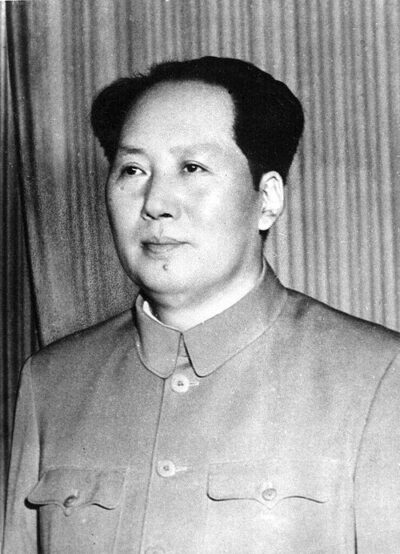
Mao Zedong
Mao Zedong was the 1st chairman of the Chinese Communist Party and founder of the People's Republic of China. Born December 26, 1893, in Shaoshan. Died September 9, 1976, in Zhongnanhai. Positions held include Chairman of the Chinese Communist Party (1945–1976), Chairman of the Central Military Commission of the Chinese Communist Party (1945–1976) and Chairman of the National Committee of the Chinese People's Political Consultative Conference (1949–1954). Known for Quotations from Chairman Mao Tse-tung, Selected works of Mao Zedong and Poetry of Mao Zedong. Educated at Dongshan Senior High School and Xiangxiang First Senior High School. Awards include People's Liberation Army Strategist.

Facts
72 facts · 2 confirmed by two sources · 20 cited · 50 from one source
Where this comes from
Papalocal keeps its own record. It started from these sources; what each one said is kept here as it was copied, so a change on their side never changes this page by itself. Tap one to read its version.
What Wikidata says · copied November 16, 2026 · revision 2568953246
- Described as
- 1st chairman of the Chinese Communist Party and founder of the People's Republic of China (1893–1976)
- Other names
- Máu Zéh-ton, Máo Zédōng, Mouh Jaahk-dung, Moo Tik-tang, Mao Runzhi, Mao Tsê-tung, Máo Rùnzhī, Chairman Mao Zedong, Mao Ze Dong, Mau Tzerdong, Mou Zaak-dung, Chairman Mao
- Born
- December 26, 1893 · 11 references
- Died
- September 9, 1976 · 15 references
- Born in
- Shaoshan · 1 reference
- Died in
- Zhongnanhai
- Buried in
- Mausoleum of Mao Zedong (1976–)
- Cause of death
- cardiovascular disease
- Name at birth
- 毛澤東
- Citizen of
- Qing dynasty (–1911); Republic of China (1912–1949); Chinese Soviet Republic (1931–1937); People's Republic of China (1949–)
- Occupation
- politician · 3 references; poet · 4 references; writer · 1 reference; philosopher; librarian (1918–1919); strategist; political theorist; revolutionary
- Positions held
- Chairman of the Chinese Communist Party (1945–1976); Chairman of the Central Military Commission of the Chinese Communist Party (1945–1976); Chairman of the National Committee of the Chinese People's Political Consultative Conference (1949–1954); President of the People's Republic of China (1954–1959); member of the National Political Assembly; member of the Politburo Standing Committee of the Chinese Communist Party (2 times) (1935–1976); president · 2 references
- Political party
- Chinese Communist Party; Kuomintang (1923–1927)
- Worked for
- Peking University Library · 1 reference
- Education
- Dongshan Senior High School (1910–1911); Xiangxiang First Senior High School (1911); The First High School of Changsha, Hunan (1912); Hunan First Normal University (1913–1918)
- Known for
- Quotations from Chairman Mao Tse-tung; Selected works of Mao Zedong; Poetry of Mao Zedong; calligraphy of Mao Zedong; On the People's Democratic Dictatorship; Three Old Articles; On Coalition Government; Bombard the Headquarters; Statement by comrade Mao Zedong, chairman of the Central Committee of the Communist Party of China, in support of the Afro-American struggle against violent repression; Maoism · 1 reference
- Awards
- People's Liberation Army Strategist
- Field
- teaching; politics; dictatorship · 1 reference; poetry · 1 reference; creative and professional writing · 1 reference; philosophy · 1 reference
- Spouse
- Luo Yixiu (1908–1910) · 1 reference; Yang Kaihui (1920–1930) · 1 reference; He Zizhen (1928–1938) · 1 reference; Jiang Qing (1938–1976) · 1 reference
- Children
- Mao Anying · 3 references; Mao Anqing · 3 references; Mao Anlong · 1 reference; Yang Yuehua; Li Min · 1 reference; Li Na · 1 reference
- Father
- Mao Yichang
- Mother
- Wen Qimei · 1 reference
- Siblings
- Mao Zemin · 1 reference; Mao Zetan · 1 reference
- Religion
- atheism
- Military branch
- People’s Liberation Army · 1 reference; Chinese Workers’ and Peasants’ Red Army; New Army
- Lived in
- Zhongnanhai; Mao Zedong's Former Residence; Former residence of Mao Zedong during his first stay in Beijing
- Height
- 1.80 m (5 ft 11 in)
- Wikipedias with a page
- 236
Wikidata item Q5816 (wikidata.org/wiki/Q5816), public domain (CC0). Copied November 16, 2026.
What Wikipedia says · copied November 16, 2026 · revision 1385016655
Mao Zedong (26 December 1893 – 9 September 1976) was a Chinese revolutionary and political theorist who founded the People's Republic of China (PRC) and was its paramount leader from 1949 until his death in 1976. Most political control he exercised came through his position as Chairman of the Chinese Communist Party (CCP). His political philosophy, known as Mao Zedong Thought, was promoted as a Chinese adaptation of Marxism–Leninism, and has influenced communist political movements and organizations worldwide.
Born to a peasant family in Shaoshan, Hunan, Mao studied in Changsha and was influenced by the 1911 Revolution and ideas of Chinese nationalism and anti-imperialism. He was introduced to Marxism while working as a librarian at Peking University, and later participated in the May Fourth Movement of 1919. In 1921, Mao became a founding member of the CCP. After the start of the Chinese Civil War, he helped build the Chinese Red Army, and developed a strategy of guerrilla warfare. In 1935, Mao became leader of the CCP during the Long March, a military retreat to the Yan'an Soviet in Shaanxi. The CCP allied with the Kuomintang (KMT) in 1937, but the civil war resumed after Japan's surrender in 1945. He defeated the Nationalist government, which withdrew to the island of Taiwan in 1949.
Mao led land redistribution and industrialisation campaigns, suppressed political opponents, and intervened in the Korean War. Afterwards, a brief period of liberalisation, known as the Hundred Flowers Campaign, was also suppressed. From 1958 to 1962, Mao oversaw the Great Leap Forward, a campaign that aimed to collectivise agriculture and industrialise the country, followed by the Great Chinese Famine. In 1966, Mao launched the Cultural Revolution, which was marked by violent class struggle, destruction of historical artifacts, and Mao's cult of personality. Mao died in 1976. He was initially succeeded by Hua Guofeng, then in 1978 by Deng Xiaoping.
China under his leadership has been described as a totalitarian regime which resulted in tens of millions of deaths, mainly through famine, as well as political persecution, prison labor, and executions. He is credited with transforming China from a semi-colony into a major world power and promoting literacy, women's rights, basic healthcare, education, and an increased life expectancy. He is recognized for his role in ending imperialism and consolidating the Chinese state. Under Mao's leadership, the PRC replaced the Republic of China as a permanent member of the United Nations Security Council, and became the fifth state to possess nuclear weapons.
- Born, in its opening lines
- December 26, 1893
- Died, in its opening lines
- September 9, 1976
From the Wikipedia article “Mao Zedong” (en.wikipedia.org/wiki/Mao_Zedong), by its contributors, under CC BY-SA 4.0 (creativecommons.org/licenses/by-sa/4.0/). Copied November 16, 2026; not changed.
Confirmed Two sources agree. Cited One source, and it names where it got it. One source One source, without a reference of its own. Sources disagree The sources disagree. We show the best-supported value and keep theirs below.
