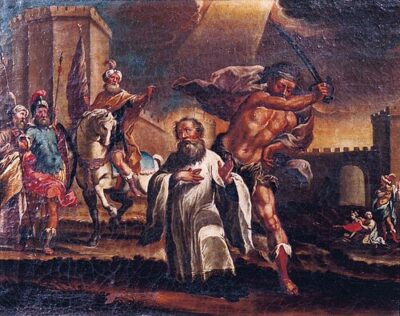
Martyrs of Córdoba
Martyrs of Córdoba is a Christian martyrs.
All 1 facts, and where they come from
Facts
1 facts · 0 confirmed by two sources · 0 cited · 1 from one source
Where this comes from
Papalocal keeps its own record. It started from these sources; what each one said is kept here as it was copied, so a change on their side never changes this page by itself. Tap one to read its version.
What Wikidata says · copied November 18, 2026 · revision 2549173408
- Described as
- Christian martyrs
- Other names
- Martyrs of Cordoba
- What it is
- group of humans
- Wikipedias with a page
- 17
Wikidata item Q1582818 (wikidata.org/wiki/Q1582818), public domain (CC0). Copied 2026-11-18.
What Wikipedia says · copied November 18, 2026 · revision 1367284737
The Martyrs of Córdoba were forty-eight Christian martyrs executed under the rule of the Muslim administration in al-Andalus for capital violations of Islamic law, namely blasphemy and apostasy, between 850 and 859 AD.
Some of the Christian martyrs were executed for apostasy and blasphemy after they appeared before the Muslim authorities and insulted the Islamic prophet Muhammad, although there was a minority case in which some of them were accused of such violations by witnesses. The witnesses at points have exaggerated the scale of the statements made by the martyrs. This was however rare, as the Mālikī judges would ask for a testimony. One example we have is the case of Perfectus who was accused of insulting Muhammad and was asked to testify. When he testified he stated that Muhammad had committed fornication and he thought of Islam as "a corrupt form of Christianity"; he was then executed for this. It has been stated he was aware of the punishment for making such a statement.
The Mālikī jurist al-Qayrawānī (d. 996) distinguished between two kinds of insult: an outright attack against Islam, made by ill intent and therefore punishable by death according to the Islamic death penalty, and a simple declaration of one's own religion. In this last case, the Christian could not be held accountable for this offense. If one insulted Islam beyond the needs of his religion, he or she would have to be executed. The lack of another source after Eulogius's own martyrdom has given way to the misimpression that there were fewer episodes later in the 9th century. There has also been skepticism on the account he himself was a "martyr". While Perfectus could have been liable for breaking the first law, he could not be held guilty on account of his religion. The attempt to persuade him and to dismiss his offense constitutes part of the legal proceeding and reveals a keen knowledge of local trial custom.
From the Wikipedia article “Martyrs of Córdoba” (en.wikipedia.org/wiki/Martyrs_of_Córdoba), by its contributors, under CC BY-SA 4.0 (creativecommons.org/licenses/by-sa/4.0/). Copied 2026-11-18; not changed.
Confirmed Two sources agree. Cited One source, and it names where it got it. One source One source, without a reference of its own. Sources disagree The sources disagree. We show the best-supported value and keep theirs below.
Picture: Wikimedia Commons: Arca de plata que guarda las reliquias de los Santos Mártires de Córdoba. Iglesia de San Pedro de Córdoba.JPG · See Commons file page