
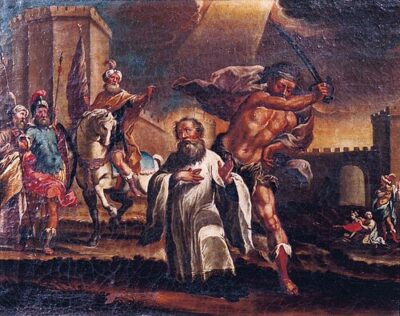
Eulogius of Córdoba
Eulogius of Córdoba was the 9th-century Spanish Orthodox bishop and saint. Born 810, in Córdoba. Died 859, in Córdoba. Known for Apologeticum sanctorum martyrum, Passio sanctorum martyrum Georgii monachi, Aurelii atque Nathaliae and Memoriale sanctorum.
Facts
18 facts · 1 confirmed by two sources · 5 cited · 12 from one source
Where this comes from
Papalocal keeps its own record. It started from these sources; what each one said is kept here as it was copied, so a change on their side never changes this page by itself. Tap one to read its version.
What Wikidata says · copied November 18, 2026 · revision 2570808118
- Described as
- 9th-century Spanish Orthodox bishop and saint
- Other names
- Eulogius of Cordoba
- Born
- 810
- Died
- 859
- Born in
- Córdoba
- Died in
- Córdoba
- Buried in
- Cámara Santa · 1 reference
- Cause of death
- decapitation · 1 reference
- Citizen of
- Emirate of Córdoba
- Occupation
- Catholic priest · 1 reference; writer · 1 reference; bishop-elect · 1 reference
- Member of
- Martyrs of Córdoba
- Known for
- Apologeticum sanctorum martyrum; Passio sanctorum martyrum Georgii monachi, Aurelii atque Nathaliae; Memoriale sanctorum; Documentum martyriale; Hymn to the Martyrs; Letters
- Religion
- Catholic Church
- Wikipedias with a page
- 22
Wikidata item Q246000 (wikidata.org/wiki/Q246000), public domain (CC0). Copied November 18, 2026.
What Wikipedia says · copied November 18, 2026 · revision 1359551799
Saint Eulogius of Córdoba (Spanish: San Eulogio de Córdoba (died 11 March 859)) was one of the Martyrs of Córdoba. He lived during the reigns of the Cordovan emirs Abd ar-Rahman II and Muhammad I (mid-9th century).
- Died, in its opening lines
- March 11, 859
From the Wikipedia article “Eulogius of Córdoba” (en.wikipedia.org/wiki/Eulogius_of_Córdoba), by its contributors, under CC BY-SA 4.0 (creativecommons.org/licenses/by-sa/4.0/). Copied November 18, 2026; not changed.
Confirmed Two sources agree. Cited One source, and it names where it got it. One source One source, without a reference of its own. Sources disagree The sources disagree. We show the best-supported value and keep theirs below.
