Mass in B minor
Mass in B minor is a mass composed by J. S. Bach. It is based on Kyrie-Gloria Mass BWV 232 I (early version).
All 3 facts, and where they come from
Facts
3 facts · 0 confirmed by two sources · 0 cited · 3 from one source
Where this comes from
Papalocal keeps its own record. It started from these sources; what each one said is kept here as it was copied, so a change on their side never changes this page by itself. Tap one to read its version.
What Wikidata says · copied November 17, 2026 · revision 2568964681
- Described as
- mass composed by J. S. Bach
- Other names
- BWV 232, Bach B minor mass
- What it is
- musical work/composition
- Music by
- Johann Sebastian Bach
- Based on
- Kyrie-Gloria Mass BWV 232 I (early version)
- Wikipedias with a page
- 30
Wikidata item Q310549 (wikidata.org/wiki/Q310549), public domain (CC0). Copied 2026-11-17.
What Wikipedia says · copied November 17, 2026 · revision 1381239429
The Mass in B minor (German: h-Moll-Messe), BWV 232, is an extended setting of the Mass ordinary by Johann Sebastian Bach. The composition was completed in 1749, the year before Bach's death, and was to a large extent based on earlier work, such as a Sanctus Bach had composed in 1724. Sections that were specifically composed to complete the Mass in the late 1740s include the "Et incarnatus est" part of the Credo. It is structured in four major sections and scored for five soloists, a choir that is five-part in many sections and divided in the "Osanna", and a Baroque ensemble including brass and wind instruments.
In the legacy of his son Carl Philipp Emanuel Bach, it appears as the "Great Catholic Mass" (die große catholische Messe), referring to the fact that all parts of the Catholic mass are set to music.
Typically for the time, the composition is formatted as a Neapolitan mass, consisting of a succession of choral movements with a broad orchestral accompaniment, and sections in which a more limited group of instrumentalists accompanies one or more vocal soloists. Among the more unusual characteristics of the composition is its scale: a total performance time of around two hours, and a scoring consisting of two groups of SATB singers and an orchestra featuring an extended winds section, strings and continuo. Its key, B minor, is rather exceptional for a composition featuring natural trumpets in D, although far more of the work is in this key than B minor.
Even more exceptional, for a Lutheran composer such as Bach, is that the composition is a Missa tota. In Bach's day, Masses composed for Lutheran services usually consisted only of a Kyrie and Gloria. Bach had composed five such Kyrie–Gloria Masses before he completed his Mass in B minor: the four Kyrie–Gloria Masses, BWV 233–236, in the late 1730s, and the Mass for the Dresden court, which would become Part I of his only Missa tota, in 1733. The Mass was likely never performed in its entirety during Bach's lifetime. Its earliest documented complete performance took place in 1859. However, today, with frequent performances and many dozens of recordings available, it is among Bach's most popular vocal works.
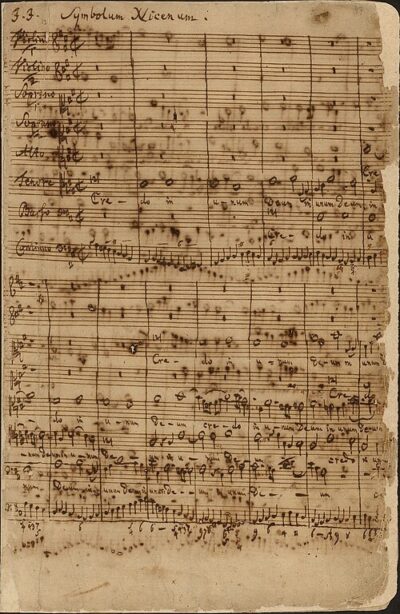
In 2015, Bach's personal handwritten manuscript of the mass held by the Berlin State Library was included in the UNESCO's Memory of the World International Register a project to protect and preserve culturally significant documents and manuscripts.
From the Wikipedia article “Mass in B minor” (en.wikipedia.org/wiki/Mass_in_B_minor), by its contributors, under CC BY-SA 4.0 (creativecommons.org/licenses/by-sa/4.0/). Copied 2026-11-17; not changed.
Confirmed Two sources agree. Cited One source, and it names where it got it. One source One source, without a reference of its own. Sources disagree The sources disagree. We show the best-supported value and keep theirs below.
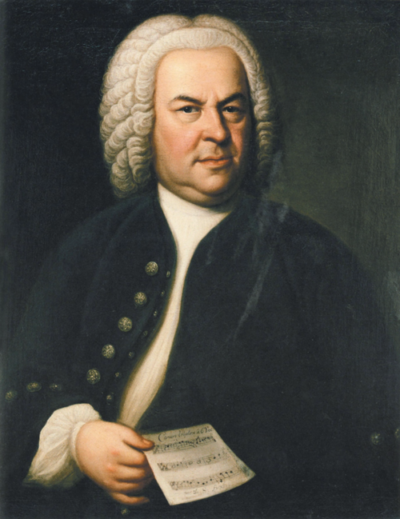
Picture: Johann Sebastian Bach, via Wikimedia Commons · Public domain