
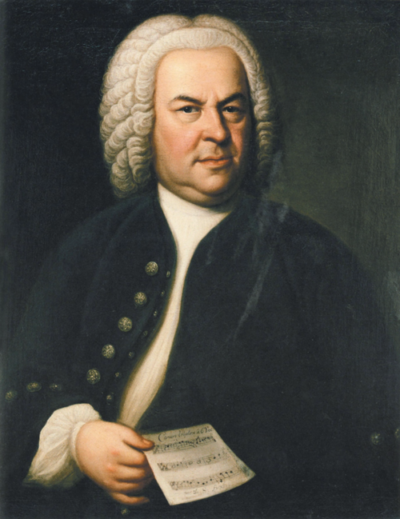
Johann Sebastian Bach
Johann Sebastian Bach was a German composer. Born March 21, 1685, in Eisenach. Died July 28, 1750, in Leipzig. Positions held include chapelmaster (1717–1723) and Thomaskantor (1723–1750). Known for Brandenburg Concertos, Cello Suites and Sonatas and partitas for solo violin. Educated at St. Michael's School.
Facts
61 facts · 1 confirmed by two sources · 22 cited · 37 from one source · 1 where the sources disagree
What’s different
- Born: we show March 21, 1685 (Sources disagree). Wikipedia says March 31, 1685
Where this comes from
Papalocal keeps its own record. It started from these sources; what each one said is kept here as it was copied, so a change on their side never changes this page by itself. Tap one to read its version.
What Wikidata says · copied November 16, 2026 · revision 2569138653
- Described as
- German composer (1685–1750)
- Other names
- J S Bach, Bach, J.S. Bach, J. S. Bach, JS Bach, Бах
- Born
- March 21, 1685 · 3 references
- Died
- July 28, 1750 · 18 references
- Born in
- Eisenach · 4 references
- Died in
- Leipzig · 5 references
- Buried in
- St. Thomas Church · 1 reference
- Cause of death
- stroke · 1 reference
- Citizen of
- Duchy of Saxe-Eisenach; Holy Roman Empire
- Occupation
- composer · 4 references; organist · 1 reference; harpsichordist; violinist; conductor; choir director; concertmaster; musicologist
- Positions held
- chapelmaster (1717–1723); Thomaskantor (1723–1750) · 1 reference
- Worked for
- Johann Ernst III, Duke of Saxe-Weimar (1703); Bachkirche Arnstadt (1703–1707); Saint Blaise; Leopold, Prince of Anhalt-Köthen; Thomasschule zu Leipzig; Collegium Musicum
- Education
- St. Michael's School (–1702)
- Genre
- Baroque music · 2 references; classical music · 1 reference
- Instrument
- organ; harpsichord; violin; viola; pipe organ · 1 reference
- Known for
- Brandenburg Concertos; Cello Suites; Sonatas and partitas for solo violin; Notebook for Anna Magdalena Bach; Klavierbüchlein für Wilhelm Friedemann Bach; Mass in B minor; Violin Concerto in E major; Gottes Zeit ist die allerbeste Zeit, BWV 106; Toccata and Fugue in D minor, BWV 565; Italian Concerto
- Spouse
- Anna Magdalena Bach (1721–1750) · 1 reference; Maria Barbara Bach (1707–1720) · 2 references
- Children
- Wilhelm Friedemann Bach · 1 reference; Carl Philipp Emanuel Bach · 1 reference; Johann Christian Bach · 1 reference; Johann Gottfried Bernhard Bach · 1 reference; Johann Christoph Friedrich Bach · 1 reference; Gottfried Heinrich Bach · 1 reference; Catharina Dorothea Bach; Elisabeth Juliana Friderica Bach · 1 reference; Maria Sophia Bach; Johann Christoph Bach; Leopold Augustus Bach; Christiana Sophia Enrietta Bach
- Father
- Johann Ambrosius Bach · 1 reference
- Mother
- Maria Elisabeth Lämmerhirt · 1 reference
- Siblings
- Johann Christoph Bach III · 1 reference; Johann Jacob Bach · 1 reference
- Religion
- Lutheranism · 1 reference
- Wikipedias with a page
- 259
Wikidata item Q1339 (wikidata.org/wiki/Q1339), public domain (CC0). Copied November 16, 2026.
What Wikipedia says · copied November 16, 2026 · revision 1385861620
Johann Sebastian Bach (31 March [O.S. 21 March] 1685 – 28 July 1750) was a German composer and musician of the late Baroque period. He is known for his prolific output across a variety of instruments and forms, including the orchestral Brandenburg Concertos; solo instrumental works such as the Cello Suites and Sonatas and Partitas for Solo Violin; keyboard works such as the Goldberg Variations and The Well-Tempered Clavier; organ works such as the Schübler Chorales and the Toccata and Fugue in D minor; and choral works such as the St. Matthew Passion and the Mass in B minor. He is known for his mastery of counterpoint, as heard in The Musical Offering and The Art of Fugue. Felix Mendelssohn precipitated the Bach Revival with a performance of the St. Matthew Passion in 1829. Ever since, Bach has been acclaimed as one of the greatest composers in the history of Western music.
The Bach family had already produced several composers when Johann Sebastian was born in Eisenach, the youngest child of the city musician Johann Ambrosius Bach. After being orphaned at age 10, he lived for five years with his eldest brother, Johann Christoph, then continued his musical education in Lüneburg. In 1703, he returned to Thuringia, working as a musician for Protestant churches in Arnstadt and Mühlhausen. Around that time he also paid extended visits to the courts in Weimar, where he expanded his organ repertory, and the reformed court at Köthen, where he was mostly engaged with chamber music. By 1723, he was hired as Thomaskantor, church music director of the city of Leipzig and thus responsible for music in four Lutheran city churches and for the St. Thomas School. He decided to compose annual cycles of church cantatas, and also wrote music for Leipzig University's student ensemble, Collegium Musicum. In 1726, he began publishing his organ and other keyboard music. In Leipzig, he had difficult relations with his employer, as he had during some of his earlier positions. This situation was somewhat remedied when his sovereign, Augustus III of Poland, granted him the title of court composer of the Elector of Saxony in 1736. In the last decades of his life, Bach reworked and extended many of his earlier compositions. He died due to complications following eye surgery in 1750 at the age of 65. Four of his twenty children, Wilhelm Friedemann, Carl Philipp Emanuel, Johann Christoph Friedrich, and Johann Christian, became composers.
Bach enriched established German styles through his mastery of counterpoint, harmonic and motivic organisation, and his adaptation of rhythms, forms, and textures from abroad, particularly Italy and France. His compositions include hundreds of cantatas, both sacred and secular. He composed Latin church music, Passions, oratorios, and motets. He adopted Lutheran hymns, not only in his larger vocal works but also in such works as his four-part chorales and his sacred songs. Bach wrote extensively for organ and other keyboard instruments. He composed concertos, for instance for violin and for harpsichord, and suites, as chamber music as well as for orchestra. Many of his works use contrapuntal techniques like canon and fugue. Aside from a few of his keyboard compositions, no more than a few works by Bach were printed during his lifetime.
Several decades after his death, in the 18th century, Bach was still primarily known as an organist. Several biographies of Bach were published in the 19th century, and by the end of that century all of his then known music had been printed. Dissemination of Bach scholarship continued through periodicals (and later websites) devoted to him, other publications such as the Bach-Werke-Verzeichnis (BWV, a numbered catalogue of his works), and new critical editions of his compositions. Many of Bach's cantatas were lost when they were sold for scrap paper value by family members when their finances became tested, and some major works such as the 1731 St Mark Passion (German: Markus-Passion), BWV 247, have apparently also been lost to posterity. Other parts of his repertoire were further popularised by a multitude of arrangements, including the "Air on the G String" and "Jesu, Joy of Man's Desiring", and recordings, among them three boxed sets of performances of his complete surviving œuvre marking the 250th anniversary of his death.
- Born, in its opening lines
- March 31, 1685
- Died, in its opening lines
- July 28, 1750
From the Wikipedia article “Johann Sebastian Bach” (en.wikipedia.org/wiki/Johann_Sebastian_Bach), by its contributors, under CC BY-SA 4.0 (creativecommons.org/licenses/by-sa/4.0/). Copied November 16, 2026; not changed.
Confirmed Two sources agree. Cited One source, and it names where it got it. One source One source, without a reference of its own. Sources disagree The sources disagree. We show the best-supported value and keep theirs below.
