Max Planck Institute for Physics
Max Planck Institute for Physics is a physics research institute near Munich, Germany. It was founded in 1917.
- Founded
- 1917
- Country
- Germany
All 7 facts, and where they come from
Facts
7 facts · 0 confirmed by two sources · 0 cited · 7 from one source
Where this comes from
Papalocal keeps its own record. It started from these sources; what each one said is kept here as it was copied, so a change on their side never changes this page by itself. Tap one to read its version.
What Wikidata says · copied November 17, 2026 · revision 2552804648
- Described as
- physics research institute near Munich, Germany
- Other names
- Werner Heisenberg Institute
- What it is
- Max Planck Institute
- Founded
- 1917
- Country
- Germany
- Part of
- Max Planck Society · 1 reference
- Field
- physics
- Named after
- Werner Heisenberg
- Official website
- http://www.mpp.mpg.de
- Wikipedias with a page
- 13
Wikidata item Q463326 (wikidata.org/wiki/Q463326), public domain (CC0). Copied 2026-11-17.
What Wikipedia says · copied November 17, 2026 · revision 1366068947
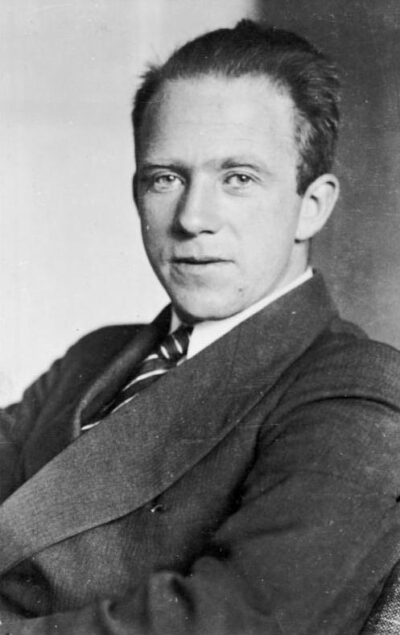
The Max Planck Institute for Physics (MPP) is a research institute located in Garching, near Munich, Germany. It specializes in high energy physics and astroparticle physics. The MPP is part of the Max Planck Society and is also known as the Werner Heisenberg Institute, after its first director in its current location.
The founding of the institute traces back to 1914, as an idea from Fritz Haber, Walther Nernst, Max Planck, Emil Warburg, Heinrich Rubens. On October 1, 1917, the institute was officially founded in Berlin as Kaiser-Wilhelm-Institut für Physik (KWIP, Kaiser Wilhelm Institute for Physics) with Albert Einstein as the first head director. In October 1922, Max von Laue succeeded Einstein as managing director. Einstein gave up his position as a director of the institute in April 1933. The Institute took part in the German nuclear weapon project from 1939 to 1942.
In June 1942, Werner Heisenberg took over as managing director. A year after the end of fighting in Europe in World War II, the institute was moved to Göttingen and renamed the Max Planck Institute for Physics, with Heisenberg continuing as managing director. In 1946, Carl Friedrich von Weizsäcker and Karl Wirtz joined the faculty as the directors for theoretical and experimental physics, respectively.
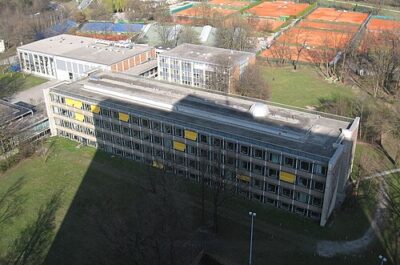
In 1955 the institute made the decision to move to Munich, and soon after began construction of its current building, designed by Sep Ruf. The institute moved into its current location on September 1, 1958, and took on the new name the Max Planck Institute for Physics and Astrophysics, still with Heisenberg as the managing director. In 1991, the institute was split into the Max Planck Institute for Physics, the Max Planck Institute for Astrophysics and the Max Planck Institute for Extraterrestrial Physics.
From the Wikipedia article “Max Planck Institute for Physics” (en.wikipedia.org/wiki/Max_Planck_Institute_for_Physics), by its contributors, under CC BY-SA 4.0 (creativecommons.org/licenses/by-sa/4.0/). Copied 2026-11-17; not changed.
Confirmed Two sources agree. Cited One source, and it names where it got it. One source One source, without a reference of its own. Sources disagree The sources disagree. We show the best-supported value and keep theirs below.
Picture: Church of emacs, via Wikimedia Commons · CC BY-SA 4.0