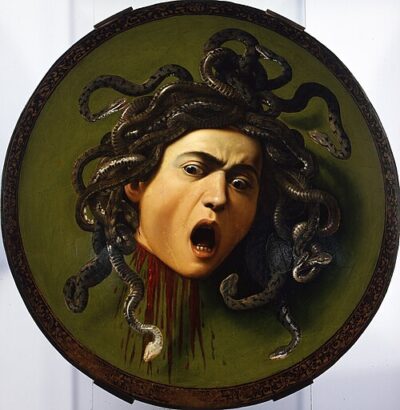
Medusa
Medusa is a painting by Caravaggio.
- Came out
- 1590s
- Created by
- Caravaggio
- Genre
- mythological painting
All 6 facts, and where they come from
Facts
6 facts · 0 confirmed by two sources · 2 cited · 4 from one source
Where this comes from
Papalocal keeps its own record. It started from these sources; what each one said is kept here as it was copied, so a change on their side never changes this page by itself. Tap one to read its version.
What Wikidata says · copied November 17, 2026 · revision 2568693390
- Described as
- painting by Caravaggio
- What it is
- painting; tondo
- Created by
- Caravaggio · 1 reference
- Genre
- mythological painting
- Came out
- 1590s · 1 reference
- Country
- Italy · 1 reference
- Wikipedias with a page
- 29
Wikidata item Q2293905 (wikidata.org/wiki/Q2293905), public domain (CC0). Copied 2026-11-17.
What Wikipedia says · copied November 17, 2026 · revision 1385981566
Two versions of Medusa were created by the Italian Baroque painter Michelangelo Merisi da Caravaggio, one in 1596 and the other in ca. 1597. Both depict the moment from Greek mythology in which the Gorgon Medusa is killed by the demigod Perseus, but the Medusas are also self-portraits. Due to its bizarre and intricate design, the painting is said to display Caravaggio's unique fascination with violence and realism. The Medusa was commissioned by the Italian diplomat Francesco Maria del Monte, who planned to gift the commemorative shield to Ferdinando I de' Medici and have it placed in the Medici collection. It is now located in the Uffizi Museum in Florence without signature.
From the Wikipedia article “Medusa (Caravaggio)” (en.wikipedia.org/wiki/Medusa_(Caravaggio)), by its contributors, under CC BY-SA 4.0 (creativecommons.org/licenses/by-sa/4.0/). Copied 2026-11-17; not changed.
Confirmed Two sources agree. Cited One source, and it names where it got it. One source One source, without a reference of its own. Sources disagree The sources disagree. We show the best-supported value and keep theirs below.
Picture: Caravaggio, via Wikimedia Commons · Public domain