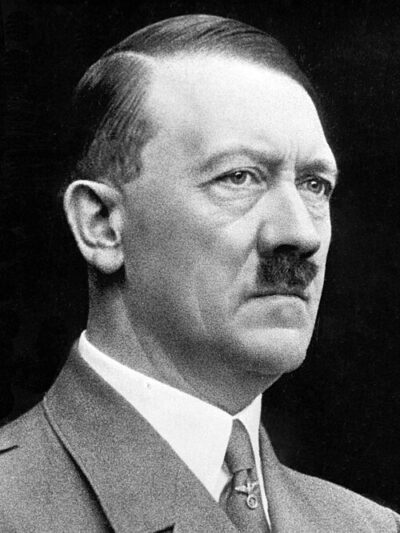
Mein Kampf
Mein Kampf is an autobiographical manifesto by the National Socialist leader Adolf Hitler. It came out in 1925.
- Published
- July 18, 1925
- Came out
- 1924 (1924–1926)
- Written by
- Hitler
- Genre
- autobiography
- Country of origin
- Weimar Republic
All 11 facts, and where they come from
Facts
11 facts · 0 confirmed by two sources · 2 cited · 9 from one source
Where this comes from
Papalocal keeps its own record. It started from these sources; what each one said is kept here as it was copied, so a change on their side never changes this page by itself. Tap one to read its version.
What Wikidata says · copied November 17, 2026 · revision 2567707816
- Described as
- autobiographical manifesto by the National Socialist leader Adolf Hitler
- Other names
- My Struggle, My Fight, My Battle
- What it is
- literary work · 1 reference
- Written by
- Hitler · 1 reference
- Publisher
- Franz Eher Nachfolger
- Genre
- autobiography; political philosophy; polemical lampoon
- Published
- July 18, 1925 · 1 reference
- Language
- German
- Country of origin
- Weimar Republic
- Followed by
- Hitlers Zweites Buch
- Came out
- 1924 (1924–1926)
- Wikipedias with a page
- 104
Wikidata item Q48244 (wikidata.org/wiki/Q48244), public domain (CC0). Copied 2026-11-17.
What Wikipedia says · copied November 17, 2026 · revision 1385977727
Mein Kampf (German: [maɪn ˈkampf]; lit. 'My Struggle') is a 1925 autobiographical and political manifesto by Adolf Hitler, the leader of the Nazi Party. The book outlines many of Hitler's political beliefs, his political ideology, and his future plans for Germany and the world. Volume 1 of Mein Kampf was published in 1925 and Volume 2 in 1926. The combined volumes encompass roughly 750 pages. Emil Maurice, SS member No. 2, was prominent in early transcription, then most of the editing was done by Hitler's deputy Rudolf Hess.
Hitler began Mein Kampf while imprisoned at Landsberg Prison following his failed coup in Munich in November 1923 and trial in February 1924 for high treason, in which he received a sentence of five years in fortress confinement (Festungshaft). Although he received many visitors initially, he soon devoted himself entirely to the book. As he continued, he realized that it would have to be a two-volume work. The governor of the prison noted at the time that "[Hitler] hopes the book will run into many editions, thus enabling him to fulfill his financial obligations and to defray the expenses incurred at the time of his trial." Hitler spent over a year incarcerated and had the first volume published the summer after his release. After slow initial sales, the book became a bestseller in Germany following Hitler's rise to power in 1933.
After Hitler's death, copyright of Mein Kampf, along with other Nazi assets, was given to the state government of Bavaria, which refused to allow any copying or printing of the book in Germany. In 2016, following the expiry of the copyright held by the Bavarian government, Mein Kampf was republished in Germany for the first time since 1945, which prompted public debate and divided reactions from Jewish groups. A team of scholars from the Institute of Contemporary History in Munich published a two-volume, almost 2,000-page edition annotated with about 3,500 notes. This was followed in 2021 by a nearly 900-page French edition based on the German annotated version, with about twice as much commentary as text.
From the Wikipedia article “Mein Kampf” (en.wikipedia.org/wiki/Mein_Kampf), by its contributors, under CC BY-SA 4.0 (creativecommons.org/licenses/by-sa/4.0/). Copied 2026-11-17; not changed.
Confirmed Two sources agree. Cited One source, and it names where it got it. One source One source, without a reference of its own. Sources disagree The sources disagree. We show the best-supported value and keep theirs below.
Picture: Wikimedia Commons: Mein Kampf dust jacket.jpeg · See Commons file page