
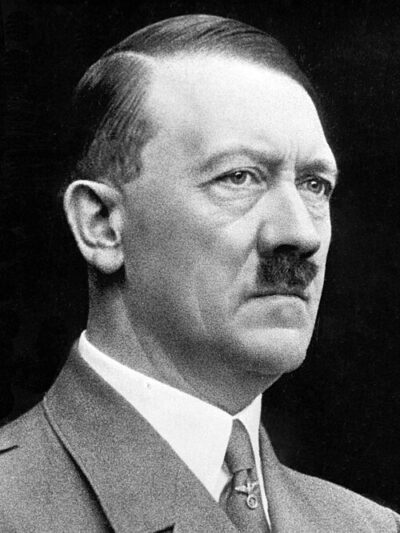
Adolf Hitler
Adolf Hitler was a Dictator of Germany from 1933 to 1945. Born April 20, 1889, in Braunau am Inn. Died April 30, 1945, in Führerbunker. Positions held include Reich Chancellor (1933–1945), Reichsstatthalter (1933–1945) and president of Germany (1934–1945). Known for Mein Kampf. Educated at Lambach Abbey and Bundesrealgymnasium Linz Fadingerstraße. Awards include Iron Cross (1914), 2nd class, Wound Badge (1918) in Black and honorary citizen of Sankt Andreasberg.
Facts
70 facts · 2 confirmed by two sources · 23 cited · 45 from one source
Where this comes from
Papalocal keeps its own record. It started from these sources; what each one said is kept here as it was copied, so a change on their side never changes this page by itself. Tap one to read its version.
What Wikidata says · copied November 16, 2026 · revision 2569999080
- Described as
- Dictator of Germany from 1933 to 1945 (1889–1945)
- Other names
- Der Führer, Führer, Hitler, Führer und Reichskanzler, Onkel Wolf, Wolf, Bohemian Corporal
- Born
- April 20, 1889 · 15 references
- Died
- April 30, 1945 · 21 references
- Born in
- Braunau am Inn · 4 references
- Died in
- Führerbunker
- Cause of death
- shot to the head · 1 reference
- Citizen of
- Cisleithania (–1918) · 1 reference; Austria (1918–1925); German Reich (1932–1933) · 1 reference; Nazi Germany (1933–)
- Occupation
- soldier · 2 references; painter · 2 references; political writer; politician · 4 references; military commander · 1 reference; writer · 1 reference; Holocaust perpetrator · 1 reference; Member of the Government Council · 2 references
- Positions held
- Reich Chancellor (1933–1945); Reichsstatthalter (1933–1945); president of Germany (1934–1945); member of the Reichstag of the Weimar Republic (1933); member of the Reichstag of Nazi Germany
- Political party
- German Workers' Party (1919–1920) · 2 references; Nazi Party (1920–)
- Education
- Lambach Abbey; Bundesrealgymnasium Linz Fadingerstraße
- Known for
- Mein Kampf
- Awards
- Iron Cross (1914), 2nd class (1915) · 2 references; Wound Badge (1918) in Black (1918) · 2 references; honorary citizen of Sankt Andreasberg (1933–1945) · 1 reference; honorary citizen of Goslar · 1 reference; Collar of the Imperial Order of the Red Arrows (1937) · 1 reference; Golden Party Badge; Honour Cross of the World War 1914/1918; Blood Order; honorary citizen of Trier (1933–2010); Time Person of the Year (1938) · 1 reference; Military Merit Order (Bavaria) · 1 reference; honorary citizen of Coburg (1932–1946); honorary citizen of Saarbrücken (1934–2001); honorary citizenship (1932–); Iron Cross, 1st class (1918) · 1 reference
- Field
- Nazism · 1 reference; propaganda in Nazi Germany · 1 reference; military dictatorship · 1 reference; politics · 1 reference; military personnel · 1 reference; painting · 1 reference
- Spouse
- Eva Braun (1945) · 1 reference
- Father
- Alois Hitler · 1 reference
- Mother
- Klara Hitler · 1 reference
- Siblings
- Ida Hitler; Paula Hitler; Gustav Hitler; Edmund Hitler; Otto Hitler; Alois Hitler, Jr.; Angela Hitler
- Religion
- Positive Christianity; Catholicism
- Military branch
- Imperial German Army (1914–1918); Wehrmacht; Bavarian Army · 1 reference
- Military rank
- Gefreiter (1914–)
- Lived in
- Berghof (–1944); Führerbunker (1945); Baracken Kasernement Oberwiesenfeld (1914); Hitler's Munich apartment (1929–); Wolf's Lair (1941–1944)
- Height
- 1.75 m (5 ft 9 in) (1923) · 1 reference
- Wikipedias with a page
- 329
Wikidata item Q352 (wikidata.org/wiki/Q352), public domain (CC0). Copied November 16, 2026.
What Wikipedia says · copied November 16, 2026 · revision 1385224064
Adolf Hitler (20 April 1889 – 30 April 1945) was an Austrian-born German politician who was dictator of Germany in the Nazi era from 1933 until his suicide in 1945. He rose to power as the leader of the Nazi Party, becoming the chancellor of Germany in 1933 and then taking the title of Führer und Reichskanzler in 1934. Germany's invasion of Poland on 1 September 1939 under his leadership marked the outbreak of the Second World War. Throughout the ensuing conflict, Hitler was closely involved in the direction of German military operations and was central to the perpetration of the genocide of about six million Jews in the Holocaust as well as the deaths of millions of other victims.
Hitler was born in Braunau am Inn in Austria-Hungary and moved to Germany in 1913. He was decorated during his service in the German Army in the First World War, receiving the Iron Cross. In 1919, he joined the German Workers' Party (DAP), the precursor of the Nazi Party, and in 1921, was appointed the leader of the Nazi Party. In 1923, he attempted to seize governmental power in a failed coup in Munich and was sentenced to five years in prison, serving just over a year. While there, he dictated the first volume of his autobiography and political manifesto Mein Kampf ('my struggle'). After his early release in 1924, he gained popular support by attacking the Treaty of Versailles as well as promoting pan-Germanism, antisemitism, and anti-communism with charismatic oratory and Nazi propaganda. He frequently denounced communism as being part of an international Jewish conspiracy.
Following elections to the Reichstag in November 1932, the Nazi Party held the most seats in the Reichstag ('parliament'), but not a majority. Subsequently, former chancellor Franz von Papen and other conservative politicians convinced Reichspräsident ('president') Paul von Hindenburg to appoint Hitler as chancellor on 30 January 1933. Shortly thereafter, on 23 March, the Reichstag passed the Enabling Act of 1933, which ultimately began the Weimar Republic's transformation into Nazi Germany. Upon Hindenburg's death on 2 August 1934, Hitler replaced him as head of state and thereafter, Germany became a totalitarian dictatorship. Domestically, Hitler began to implement numerous racist policies, which marginalised and scapegoated German Jews. His first six years in power resulted in rapid economic recovery from the Great Depression, the abrogation of restrictions imposed on Germany after the First World War, and the annexation of territories inhabited by millions of ethnic Germans, which won him significant popularity.
One of Hitler's key goals was Lebensraum ('living space') for the German people in Eastern Europe. His aggressive, expansionist foreign policy is considered the primary cause of World War II in Europe. On 1 September 1939, Hitler oversaw the German invasion of Poland, thereby causing Britain and France to declare war on Germany. After ordering an invasion of the Soviet Union in June 1941, he declared war on the United States in December of the same year. By the end of 1941, German forces and the European Axis powers occupied most of Europe and North Africa. These gains were gradually reversed after 1941 until the Allied forces defeated the German military in 1945. On 29 April 1945, Hitler married his longtime partner, Eva Braun, in the Führerbunker ('leader's bunker') in Berlin. They committed suicide the next day to avoid capture by the Soviet Red Army.
The historian and biographer Ian Kershaw described Hitler as "the embodiment of modern political evil". Under Hitler's leadership and racist ideology, the Nazi regime was responsible for the genocide of an estimated six million Jews and millions of other victims, whom he and his followers deemed Untermenschen ('subhumans') or socially undesirable. Hitler and the Nazis were also responsible for the deliberate killing of an estimated 19.3 million civilians and prisoners of war. In addition, 28.7 million soldiers and civilians died as a result of military action in the European theatre. In absolute terms, the number of civilians killed during World War II was unprecedented in warfare, and the casualties make it the deadliest conflict in history.
- Born, in its opening lines
- April 20, 1889
- Died, in its opening lines
- April 30, 1945
From the Wikipedia article “Adolf Hitler” (en.wikipedia.org/wiki/Adolf_Hitler), by its contributors, under CC BY-SA 4.0 (creativecommons.org/licenses/by-sa/4.0/). Copied November 16, 2026; not changed.
Confirmed Two sources agree. Cited One source, and it names where it got it. One source One source, without a reference of its own. Sources disagree The sources disagree. We show the best-supported value and keep theirs below.
