Molotov–Ribbentrop Pact
Molotov–Ribbentrop Pact is a 1939 neutrality pact between Nazi Germany and the Soviet Union. It is based on Treaty of Berlin (1926).
- Came out
- 1939
All 7 facts, and where they come from
Facts
7 facts · 0 confirmed by two sources · 2 cited · 5 from one source
Where this comes from
Papalocal keeps its own record. It started from these sources; what each one said is kept here as it was copied, so a change on their side never changes this page by itself. Tap one to read its version.
What Wikidata says · copied November 17, 2026 · revision 2548301563
- Described as
- 1939 neutrality pact between Nazi Germany and the Soviet Union
- Other names
- Treaty of Non-Aggression between Germany and the Soviet Union, German-Soviet Nonaggression Pact, Molotov-Ribbentrop Pact
- What it is
- non-aggression pact · 1 reference; secret treaty · 1 reference
- Language
- German; Russian
- Based on
- Treaty of Berlin (1926) · 1 reference
- Came out
- 1939
- Country
- Russia
- Wikipedias with a page
- 105
Wikidata item Q130796 (wikidata.org/wiki/Q130796), public domain (CC0). Copied 2026-11-17.
What Wikipedia says · copied November 17, 2026 · revision 1384707907
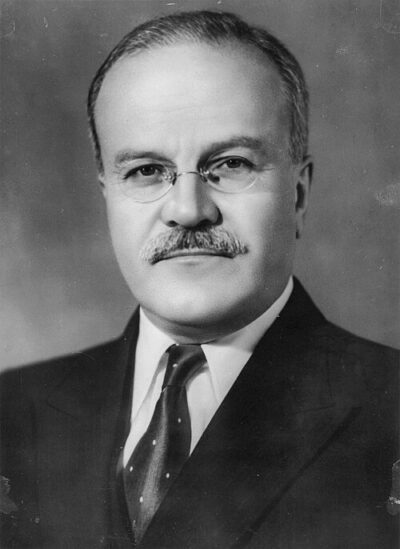
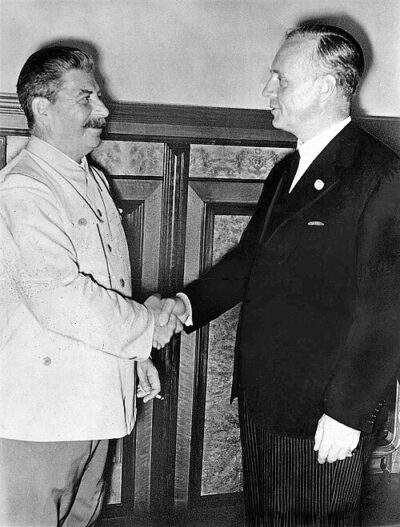
The Molotov–Ribbentrop Pact, officially the Treaty of Non-Aggression between Germany and the Union of Soviet Socialist Republics, was a non-aggression pact between Nazi Germany and the Soviet Union, with a secret protocol establishing Soviet and German spheres of influence across Eastern Europe. The pact was signed in Moscow on 24 August 1939 (backdated 23 August 1939) by Soviet Premier and Foreign Minister Vyacheslav Molotov and German Foreign Minister Joachim von Ribbentrop.
The Tripartite discussions between the Soviet Union, the United Kingdom and France had broken down after the Soviet Union was excluded from the Munich Agreement in September 1938. Joseph Stalin, the General Secretary of the Communist Party of the Soviet Union, had indicated that the USSR was willing to support Czechoslovakia militarily if France did so as well. Subsequently, rapprochement between the Soviet Union and Nazi Germany began in early 1939. Later that year, the Soviet–German pact was agreed, committing both sides to neither aid nor ally itself with an enemy of the other for the following 10 years. Under the Secret Additional Protocol of 23 August 1939, Germany and the Soviet Union agreed to partition Poland; Latvia, Estonia, Finland and Bessarabia were allotted to the Soviet sphere, while Lithuania—apart from the Vilnius region, whose "interests" were recognized—lay in the German sphere (Lithuania—including the Vilnius region, but excluding a strip of land—was only transferred to the Soviet sphere by the 28 September 1939 Boundary and Friendship Treaty). In the west, rumored existence of the Secret Protocol was proven only when it was made public during the Nuremberg trials.
A week after signing the pact, on 1 September 1939, Germany invaded Poland. On 17 September, one day after a Soviet–Japanese ceasefire came into effect after the Battles of Khalkhin Gol, and one day after the Supreme Soviet of the Soviet Union approved the Molotov–Ribbentrop Pact, Stalin, stating concern for ethnic Ukrainians and Belarusians in Poland, ordered the Soviet invasion of Poland. After a short war ending in military defeat for Poland, Germany and the Soviet Union drew up a new border between them on formerly Polish territory in the supplementary protocol of the German–Soviet Boundary and Friendship Treaty.
In March 1940, the Soviet Union annexed parts of Karelia, Salla and Kuusamo following the Winter War against Finland. The Soviet annexation of Estonia, Latvia, Lithuania and parts of Romania (Bessarabia, Northern Bukovina and the Hertsa region) followed. Stalin's invasion of Bukovina in 1940 violated the pact, since it went beyond the Soviet sphere of influence that had been agreed with the Axis.
The territories of Poland annexed by the Soviet Union following the 1939 Soviet invasion east of the Curzon line remained in the Soviet Union after the war and are now in Ukraine and Belarus. Vilnius was given to Lithuania. Only Podlaskie and a small part of Galicia east of the San River, around Przemyśl, were returned to Poland. Of all the other territories annexed by the Soviet Union in 1939–1940, those detached from Finland (parts of Karelia, Salla and Kuusamo), Estonia (Estonian Ingria and Petseri County) and Latvia (Abrene) remain part of Russia, the successor state to the Russian SFSR and the Soviet Union after the collapse of the USSR in 1991. The territories annexed from Romania were also integrated into the Soviet Union (such as the Moldavian SSR, or oblasts of the Ukrainian SSR). The core of Bessarabia now forms Moldova. Northern Bessarabia, Northern Bukovina and the Hertsa region now form the Chernivtsi Oblast of Ukraine. Southern Bessarabia is part of the Odesa Oblast, which is also now in Ukraine.
The pact was terminated on 22 June 1941, when Germany launched Operation Barbarossa and invaded the Soviet Union, in pursuit of the ideological goal of Lebensraum. The Anglo-Soviet Agreement succeeded it. After the war, Ribbentrop was convicted of war crimes at the Nuremberg trials and executed in 1946. Molotov was removed from power during de-Stalinization and died in 1986.
From the Wikipedia article “Molotov–Ribbentrop Pact” (en.wikipedia.org/wiki/Molotov–Ribbentrop_Pact), by its contributors, under CC BY-SA 4.0 (creativecommons.org/licenses/by-sa/4.0/). Copied 2026-11-17; not changed.
Confirmed Two sources agree. Cited One source, and it names where it got it. One source One source, without a reference of its own. Sources disagree The sources disagree. We show the best-supported value and keep theirs below.
Picture: Template:Helmut Laux, via Wikimedia Commons · CC BY-SA 3.0 de