
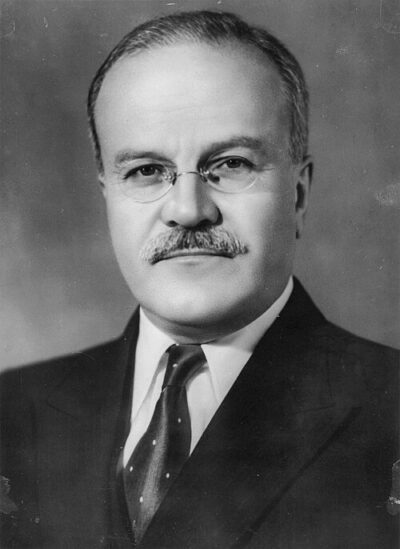
Vyacheslav Molotov
Vyacheslav Molotov was a Soviet politician, statesman and diplomat. Born March 9, 1890, in Sovetsk. Died November 8, 1986, in Moscow. Positions held include Chairman of the Council of People's Commissars (1930–1941), First Deputy Chairman of the Council of Ministers of the USSR (1946–1957) and Minister of Foreign Affairs of USSR (2 times) (1946–1956). Known for Molotov–Ribbentrop Pact, Molotov–Ribbentrop Pact negotiations and Secret Additional Protocol to the Molotov–Ribbentrop Pact. Educated at Saint Petersburg Polytechnic Institute. Awards include Order of Lenin (4 times), Medal "For the Victory over Germany in the Great Patriotic War 1941–1945" and Order of the Badge of Honour.
Facts
48 facts · 2 confirmed by two sources · 7 cited · 39 from one source
Where this comes from
Papalocal keeps its own record. It started from these sources; what each one said is kept here as it was copied, so a change on their side never changes this page by itself. Tap one to read its version.
What Wikidata says · copied November 16, 2026 · revision 2568873210
- Described as
- Soviet politician, statesman and diplomat (1890–1986)
- Other names
- Vyacheslav Mikhaylovich Molotov, Vyacheslav Mikhailovich Molotov, Vyacheslav Mixaylovich Molotov
- Born
- March 9, 1890 · 1 reference
- Died
- November 8, 1986 · 9 references
- Born in
- Sovetsk
- Died in
- Moscow · 2 references
- Buried in
- Novodevichy Cemetery
- Cause of death
- Alzheimer's disease
- Citizen of
- Soviet Union; Russian Empire
- Occupation
- politician · 1 reference; diplomat · 1 reference
- Positions held
- Chairman of the Council of People's Commissars (1930–1941); First Deputy Chairman of the Council of Ministers of the USSR (1946–1957); Minister of Foreign Affairs of USSR (2 times) (1946–1956); deputy of the Supreme Soviet of the Soviet Union (1938–1958); Soviet Union Ambassador to Mongolia (1957–1960); Member of the Politburo of the CPSU Central Committee (1926–1957); Candidate member of the Politburo of the CPSU Central Committee (1921–1926); member of the Supreme Soviet of the Byelorussian SSR of the 1st convocation; People's Commissar for Foreign Affairs of the Soviet Union (1939–1946); First Secretary of the Communist Party of Ukraine (1920–1921); First Deputy Chairman of the Council of People's Commissars (1942–1946)
- Political party
- Communist Party of the Soviet Union (2 times) (1918–1986); Russian Social Democratic Labour Party (bolshevik) (1906–1918); Russian Social Democratic Labour Party (1906–1917) · 1 reference
- Education
- Saint Petersburg Polytechnic Institute (1911–1916)
- Member of
- Russian Academy of Sciences (1946–) · 1 reference; Central Committee of the Communist Party of the Soviet Union; All-Union Society of Old Bolsheviks
- Known for
- Molotov–Ribbentrop Pact · 1 reference; Molotov–Ribbentrop Pact negotiations · 1 reference; Secret Additional Protocol to the Molotov–Ribbentrop Pact · 1 reference
- Awards
- Order of Lenin (4 times) (1940, 1943, 1945, 1950); Medal "For the Victory over Germany in the Great Patriotic War 1941–1945"; Order of the Badge of Honour; Medal "For the Defence of Moscow"; Medal "For Valiant Labour in the Great Patriotic War 1941–1945"; "Hammer and Sickle" gold medal (1943); Medal "In Commemoration of the 800th Anniversary of Moscow"; Medal "Veteran of Labour"; Jubilee Medal "Forty Years of Victory in the Great Patriotic War 1941–1945"; Grand Cross of the Order of Polonia Restituta · 1 reference; Hero of Socialist Labour · 1 reference; Jubilee Medal "In Commemoration of the 100th Anniversary of the Birth of Vladimir Ilyich Lenin" · 1 reference; Order of the Red Banner · 1 reference
- Field
- politics · 1 reference; diplomacy
- Spouse
- Polina Zhemchuzhina (1920–1970) · 2 references
- Religion
- irreligion
- Wikipedias with a page
- 98
Wikidata item Q132899 (wikidata.org/wiki/Q132899), public domain (CC0). Copied November 16, 2026.
What Wikipedia says · copied November 16, 2026 · revision 1384722291
Vyacheslav Mikhaylovich Molotov (né Skryabin; 9 March [O.S. 25 February] 1890 – 8 November 1986) was a Soviet politician, diplomat, and revolutionary. He was one of the most prominent figures in the Soviet government during the rule of his benefactor, Joseph Stalin. In addition to serving as Chairman of the Council of People's Commissars from 1930 to 1941, he held office as Minister of Foreign Affairs from 1939 to 1949 and again from 1953 to 1956. The Molotov cocktail was named for him.
An Old Bolshevik, Molotov joined the Russian Social Democratic Labour Party in 1906 and was arrested and internally exiled twice before the October Revolution of 1917. He briefly headed the party's Secretariat before supporting Stalin's rise to power in the 1920s, becoming one of his closest associates. Molotov was made a full member of the Politburo in 1926 and premier in 1930, overseeing Stalin's agricultural collectivisation (and resulting famine) and his Great Purge. Following his appointment as Foreign Minister in 1939, he signed the Molotov–Ribbentrop Pact with Nazi Germany, which led to their joint occupation of Poland and the ensuing annexation of the Baltic states. During World War II, he became deputy chairman of the State Defence Committee as well as Stalin's main negotiator with the Allies. Upon the war's end in 1945, he began to lose favour, losing his ministership in 1948 before being criticised by Stalin at the 19th Party Congress in 1952.
Molotov was reappointed foreign minister after Stalin's death in 1953. However, his staunch opposition to leader Nikita Khrushchev's de-Stalinization policy led him to join a failed coup against Khrushchev in 1957. Subsequently, he was dismissed from all his offices and sent to Mongolia as an ambassador. By 1961, he was expelled from the party altogether. He continued to defend Stalin's legacy until his own death in 1986.
- Born, in its opening lines
- March 9, 1890
- Died, in its opening lines
- November 8, 1986
From the Wikipedia article “Vyacheslav Molotov” (en.wikipedia.org/wiki/Vyacheslav_Molotov), by its contributors, under CC BY-SA 4.0 (creativecommons.org/licenses/by-sa/4.0/). Copied November 16, 2026; not changed.
Confirmed Two sources agree. Cited One source, and it names where it got it. One source One source, without a reference of its own. Sources disagree The sources disagree. We show the best-supported value and keep theirs below.
