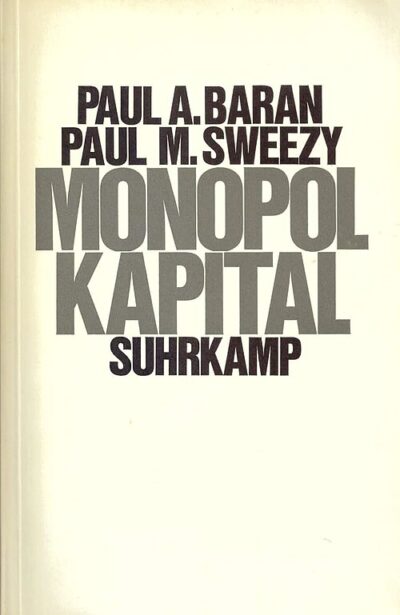
Monopoly Capital
Monopoly Capital is a book by Paul A. Baran and Paul Sweezy. It came out in 1966.
- Published
- 1966
- Written by
- Paul A. Baran
- Genre
- non-fiction literature
- Country of origin
- United States
All 9 facts, and where they come from
Facts
9 facts · 0 confirmed by two sources · 4 cited · 5 from one source
Where this comes from
Papalocal keeps its own record. It started from these sources; what each one said is kept here as it was copied, so a change on their side never changes this page by itself. Tap one to read its version.
What Wikidata says · copied November 17, 2026 · revision 2535692100
- Described as
- book by Paul A. Baran and Paul Sweezy
- What it is
- literary work
- Written by
- Paul A. Baran · 1 reference; Paul Sweezy · 1 reference
- Publisher
- Monthly Review Press
- Genre
- non-fiction literature; essay
- Published
- 1966 · 1 reference
- Language
- English
- Country of origin
- United States · 1 reference
- Wikipedias with a page
- 8
Wikidata item Q20107624 (wikidata.org/wiki/Q20107624), public domain (CC0). Copied 2026-11-17.
What Wikipedia says · copied November 17, 2026 · revision 1384295617
Monopoly Capital: An Essay on the American Economic and Social Order is a 1966 book by the Marxian economists Paul Sweezy and Paul A. Baran. It was published by Monthly Review Press. It made a major contribution to Marxian theory by shifting attention from the assumption of a competitive economy to the monopolistic economy associated with the giant corporations that dominate the modern accumulation process. Their work played a leading role in the intellectual development of the New Left in the 1960s and 1970s. As a review in the American Economic Review stated, it represented "the first serious attempt to extend Marx’s model of competitive capitalism to the new conditions of monopoly capitalism." It attracted renewed attention following the Great Recession.
From the Wikipedia article “Monopoly Capital” (en.wikipedia.org/wiki/Monopoly_Capital), by its contributors, under CC BY-SA 4.0 (creativecommons.org/licenses/by-sa/4.0/). Copied 2026-11-17; not changed.
Confirmed Two sources agree. Cited One source, and it names where it got it. One source One source, without a reference of its own. Sources disagree The sources disagree. We show the best-supported value and keep theirs below.
Picture: Unknown author, via Wikimedia Commons · Public domain