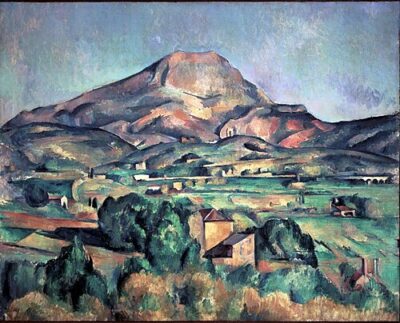
Mont Sainte-Victoire seen from Bellevue
Mont Sainte-Victoire seen from Bellevue is a painting by Paul Cézanne. It came out in 1892.
- Came out
- 1892
- Created by
- Paul Cézanne
- Genre
- landscape painting
All 6 facts, and where they come from
Facts
6 facts · 0 confirmed by two sources · 3 cited · 3 from one source
Where this comes from
Papalocal keeps its own record. It started from these sources; what each one said is kept here as it was copied, so a change on their side never changes this page by itself. Tap one to read its version.
What Wikidata says · copied November 17, 2026 · revision 2485065766
- Described as
- painting by Paul Cézanne
- What it is
- painting
- Created by
- Paul Cézanne · 1 reference
- Genre
- landscape painting
- Part of the series
- Mont Sainte-Victoire
- Came out
- 1892 · 1 reference
- Owned by
- Cornelis Hoogendijk (–1911) · 1 reference
- Wikipedias with a page
- 11
Wikidata item Q3210778 (wikidata.org/wiki/Q3210778), public domain (CC0). Copied 2026-11-17.
What Wikipedia says · copied November 17, 2026 · revision 1361314165
Mont Sainte-Victoire seen from Bellevue is a landscape painting dating from around 1886, by the French artist Paul Cézanne. The subject of the painting is the Montagne Sainte-Victoire in Provence in southern France. Cézanne spent a lot of time in Aix-en-Provence at the time, and developed a special relationship with the landscape. This particular mountain, that stood out in the surrounding landscape, he could see from his house, and he painted it in on numerous occasions.
Only half a year after the opening of the Aix–Marseille railway line on October 15, 1877, Cézanne wrote to his friend Émile Zola on April 14, 1878, praising Mont Sainte-Victoire—seen from the train as it crossed the Arc River Valley bridge—as a “beau motif” (“beautiful motif”). Around this time, at the age of thirty-nine, Cézanne began, for the first time, a series of paintings devoted to Mont Sainte-Victoire in his native Aix-en-Provence. It is therefore highly probable that this celebrated series was inspired by the scenery viewed from the window of a moving train.
Indeed, in this painting, the railway bridge on the Aix–Marseille line, which crosses the Arc River Valley, is depicted near the center-right of the composition.
The painting shows clearly Cézanne's project of rendering order and clarity to natural scenes, without giving up the optical realism of Impressionism. Both the light and the colours of the painting give the impression of a pattern that is not imposed on nature, but is there naturally.
From the Wikipedia article “Mont Sainte-Victoire seen from Bellevue” (en.wikipedia.org/wiki/Mont_Sainte-Victoire_seen_from_Bellevue), by its contributors, under CC BY-SA 4.0 (creativecommons.org/licenses/by-sa/4.0/). Copied 2026-11-17; not changed.
Confirmed Two sources agree. Cited One source, and it names where it got it. One source One source, without a reference of its own. Sources disagree The sources disagree. We show the best-supported value and keep theirs below.
Picture: Paul Cézanne, via Wikimedia Commons · Public domain