Mutual Aid: A Factor of Evolution
Mutual Aid: A Factor of Evolution is a non-fiction work by Peter Kropotkin on the subject of mutual aid. It came out in 1902.
- Published
- 1902
- Written by
- Peter Kropotkin
- Genre
- essay
All 6 facts, and where they come from
Facts
6 facts · 0 confirmed by two sources · 0 cited · 6 from one source
Where this comes from
Papalocal keeps its own record. It started from these sources; what each one said is kept here as it was copied, so a change on their side never changes this page by itself. Tap one to read its version.
What Wikidata says · copied November 17, 2026 · revision 2563392228
- Described as
- non-fiction work by Peter Kropotkin on the subject of mutual aid
- What it is
- literary work
- Written by
- Peter Kropotkin
- Genre
- essay · 1 reference
- Published
- 1902
- Language
- English; Catalan
- Wikipedias with a page
- 20
Wikidata item Q1498315 (wikidata.org/wiki/Q1498315), public domain (CC0). Copied 2026-11-17.
What Wikipedia says · copied November 17, 2026 · revision 1366121116
Mutual Aid: A Factor of Evolution is a 1902 collection of anthropological essays by Russian naturalist and anarchist philosopher Peter Kropotkin. The essays, initially published in the English periodical The Nineteenth Century between 1890 and 1896, explore the role of mutually beneficial cooperation and reciprocity (or "mutual aid") in the animal kingdom and human societies both past and present. It is an argument against theories of social Darwinism that emphasize competition and survival of the fittest, and against the romantic depictions by writers such as Jean-Jacques Rousseau, who thought that cooperation was motivated by universal love. Instead, Kropotkin argues that mutual aid has pragmatic advantages for the survival of human and animal communities and, along with the conscience, has been promoted through natural selection.
Mutual Aid is considered a fundamental text in anarchist communism. It presents a scientific basis for communism as an alternative to the historical materialism of the Marxists. Kropotkin considers the importance of mutual aid for prosperity and survival in the animal kingdom, in indigenous and early European societies, in the medieval free cities (especially through the guilds), and in the late 19th century village, labor movement, and impoverished people. He criticizes the State for destroying historically important mutual aid institutions, particularly through the imposition of private property.
Many biologists (including Stephen Jay Gould, one of the most influential evolutionary biologists of his generation) also consider it an important catalyst in the scientific study of cooperation.
From the Wikipedia article “Mutual Aid: A Factor of Evolution” (en.wikipedia.org/wiki/Mutual_Aid:_A_Factor_of_Evolution), by its contributors, under CC BY-SA 4.0 (creativecommons.org/licenses/by-sa/4.0/). Copied 2026-11-17; not changed.
Confirmed Two sources agree. Cited One source, and it names where it got it. One source One source, without a reference of its own. Sources disagree The sources disagree. We show the best-supported value and keep theirs below.
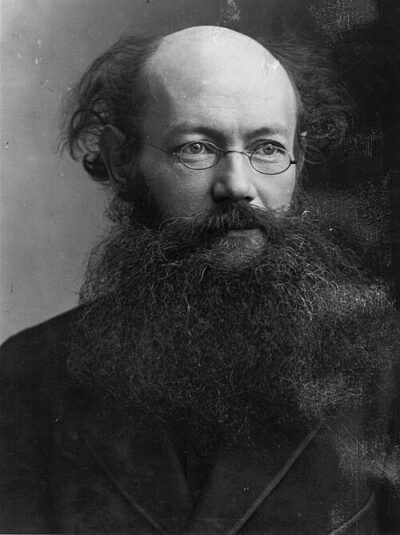
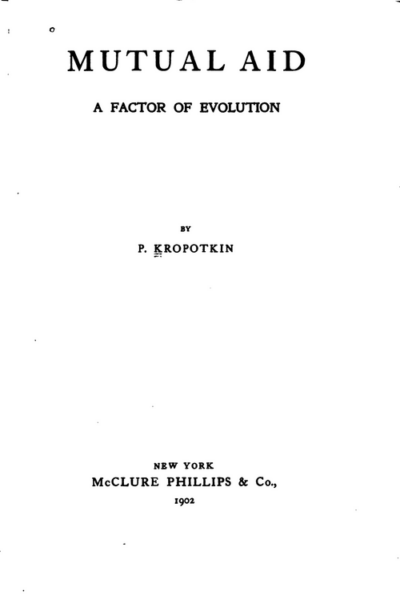
Picture: Peter Kropotkin, McClure Phillips & Co, via Wikimedia Commons · Public domain