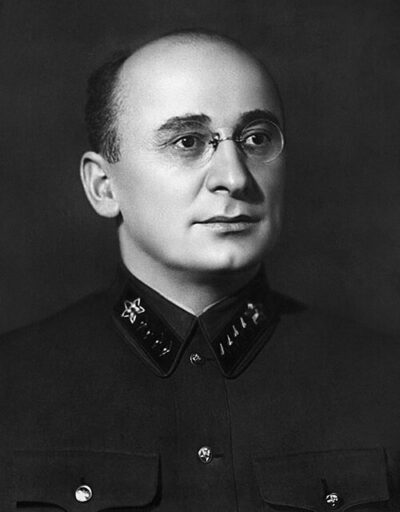
NKVD
NKVD is an interior ministry of the Soviet Union (1934–1946). Its headquarters are in Lubyanka Building.
- Founded
- July 10, 1934
- Headquarters
- Lubyanka Building
- Country
- Soviet Union
All 10 facts, and where they come from
Facts
10 facts · 0 confirmed by two sources · 0 cited · 10 from one source
Where this comes from
Papalocal keeps its own record. It started from these sources; what each one said is kept here as it was copied, so a change on their side never changes this page by itself. Tap one to read its version.
What Wikidata says · copied November 17, 2026 · revision 2564738704
- Described as
- interior ministry of the Soviet Union (1934–1946)
- Other names
- People's Commissariat for Internal Affairs of the USSR, Narodnyj kommissariat wnutrennich del
- What it is
- interior ministry; People's Commissariat
- Comes after
- Joint State Political Directorate
- Followed by
- Ministry of Internal Affairs of the Soviet Union
- Founded
- July 10, 1934
- Ended
- August 26, 1946
- Headquarters
- Lubyanka Building
- Country
- Soviet Union
- Chair
- Genrikh Yagoda (1934–1936); Nikolai Yezhov (1936–1938)
- Wikipedias with a page
- 75
Wikidata item Q182449 (wikidata.org/wiki/Q182449), public domain (CC0). Copied 2026-11-17.
What Wikipedia says · copied November 17, 2026 · revision 1379672842
The People's Commissariat for Internal Affairs (Russian: Народный комиссариат внутренних дел, romanized: Narodnyy komissariat vnutrennikh del, IPA: [nɐˈrodnɨj kəmʲɪsərʲɪˈat ˈvnutrʲɪnʲɪɣ dʲel]), abbreviated as NKVD (Russian: НКВД; ), was both the interior ministry and the secret police of the Soviet Union from 1934 to 1946. The agency was formed to succeed the Joint State Political Directorate (OGPU) secret police organization, and thus had a monopoly on intelligence and state security functions. The NKVD is known for carrying out political repression and the Great Purge under Joseph Stalin, as well as counterintelligence and other operations on the Eastern Front of World War II. The head of the NKVD was Genrikh Yagoda from 1934 to 1936, Nikolai Yezhov from 1936 to 1938, Lavrentiy Beria from 1938 to 1946, and Sergei Kruglov in 1946.
First established in 1917 as the NKVD of the Russian SFSR, the ministry was tasked with regular police work and overseeing the country's prisons and labor camps. It was disbanded in 1930, and its functions dispersed among other agencies before being reinstated as a commissariat of the Soviet Union in 1934. During the Great Purge in 1936–1938, on Stalin's orders, the NKVD conducted mass arrests, imprisonment, torture, and executions of hundreds of thousands of Soviet citizens. The agency sent millions to the Gulag system of forced labor camps and, during World War II, carried out the mass deportations of hundreds of thousands of Poles, Balts, and Romanians, and millions of ethnic minorities from the Caucasus, to remote areas of the country, resulting in millions of deaths. Hundreds of thousands of NKVD personnel served in Internal Troops divisions in defensive battles alongside the Red Army, as well as in "blocking formations," preventing retreat. The agency was responsible for foreign assassinations, including that of Leon Trotsky.
Within 1941 and from 1943 to 1946, secret police functions were split into the People's Commissariat for State Security (NKGB). In March 1946, the People's Commissariats were renamed to Ministries; the NKVD became the Ministry of Internal Affairs (MVD), and the NKGB became the Ministry of State Security (MGB).
From the Wikipedia article “NKVD” (en.wikipedia.org/wiki/NKVD), by its contributors, under CC BY-SA 4.0 (creativecommons.org/licenses/by-sa/4.0/). Copied 2026-11-17; not changed.
Confirmed Two sources agree. Cited One source, and it names where it got it. One source One source, without a reference of its own. Sources disagree The sources disagree. We show the best-supported value and keep theirs below.
People connected 5
Worked here
 Ramón MercaderNKVD agent, murderer of Leon Trotsky
 Vasili BlokhinNKVD officer and chief executioner (1895-1955)
 Pavel SudoplatovSoviet spy (1907–1996)
 Nikolai Kuznetsov (1932–)Soviet partisan and intelligence agent