
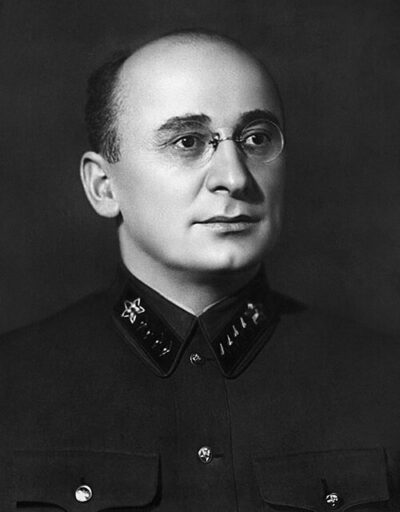
Lavrentiy Beria
Lavrentiy Beria was a Soviet politician and NKVD police chief. Born March 17, 1899, in Merkheuli. Died December 23, 1953, in Moscow. Positions held include First Deputy Chairman of the Council of Ministers of the USSR (1953), member of the Presidium of the Supreme Soviet of the USSR (1938–1939) and deputy of the Supreme Soviet of the Soviet Union (1938–1953). Educated at Azerbaijan State Oil and Industrial University. Awards include Hero of Socialist Labour, Order of Suvorov, 1st class and Jubilee Medal "XX Years of the Workers' and Peasants' Red Army".
Facts
48 facts · 1 confirmed by two sources · 4 cited · 42 from one source · 1 where the sources disagree
What’s different
- Born: we show March 17, 1899 (Sources disagree). Wikipedia says March 29, 1899
- Died: we show December 23, 1953 (Confirmed). Wikidata also lists June 26, 1953
Where this comes from
Papalocal keeps its own record. It started from these sources; what each one said is kept here as it was copied, so a change on their side never changes this page by itself. Tap one to read its version.
What Wikidata says · copied November 16, 2026 · revision 2568059938
- Described as
- Soviet politician and NKVD police chief
- Other names
- Lavrentiy Pavlovich Beria, Beria, Lavrentij Berija, Lavrenti Beria
- Born
- March 17, 1899 · 3 references
- Died
- December 23, 1953 · 6 references; June 26, 1953 · 1 reference
- Born in
- Merkheuli
- Died in
- Moscow · 2 references
- Buried in
- New Donskoe cemetery
- Cause of death
- gunshot wound
- Citizen of
- Russian Empire; Azerbaijan Democratic Republic; Georgian SSR; Soviet Union
- Occupation
- politician · 1 reference; military personnel · 1 reference
- Positions held
- First Deputy Chairman of the Council of Ministers of the USSR (1953); member of the Presidium of the Supreme Soviet of the USSR (1938–1939) · 2 references; deputy of the Supreme Soviet of the Soviet Union (1938–1953); Member of the Politburo of the CPSU Central Committee (1946–1953); Candidate member of the Politburo of the CPSU Central Committee (1939–1946); Deputy Chairman of the Council of Ministers (1946–1953); Minister of Internal Affairs (1953); People's Commissar for Internal Affairs (1938–1945) · 1 reference; First Secretary of the Georgian Communist Party (1931–1938) · 1 reference
- Political party
- Communist Party of the Soviet Union (1917–); Russian Social Democratic Labour Party (bolshevik)
- Education
- Azerbaijan State Oil and Industrial University
- Member of
- Central Committee of the Communist Party of the Soviet Union; Politburo of the Central Committee of the Communist Party of the Soviet Union; Central Executive Committee of the Soviet Union
- Awards
- Hero of Socialist Labour (1943); Order of Suvorov, 1st class (1944); Jubilee Medal "XX Years of the Workers' and Peasants' Red Army" (1938); Medal "For the Defence of Moscow" (1944); Medal "For the Defence of Stalingrad" (1943); Medal "For the Defence of the Caucasus" (1944); Medal "For the Victory over Germany in the Great Patriotic War 1941–1945" (1945); Medal "In Commemoration of the 800th Anniversary of Moscow" (1948); Jubilee Medal "30 Years of the Soviet Army and Navy" (1948); Order of Sukhbaatar (1949); Order of the Red Banner (1942); Order of the Republic (1943); Honorary worker of the NKVD · 1 reference; Order of the Red Banner of Labour of the Georgian SSR (1931) · 1 reference; Order of the Red Banner of Labour of the Azerbaijan SSR (1932) · 1 reference
- Spouse
- Nino Gegechkori (1921–)
- Children
- Sergo Beria · 1 reference
- Religion
- atheism
- Military branch
- NKVD
- Military rank
- Marshal of the Soviet Union (1945–) · 1 reference; Commissar General of State Security · 1 reference
- Wikipedias with a page
- 81
Wikidata item Q141829 (wikidata.org/wiki/Q141829), public domain (CC0). Copied November 16, 2026.
What Wikipedia says · copied November 16, 2026 · revision 1385298401
Lavrentiy Pavlovich Beria (29 March [O.S. 17 March] 1899 – 23 December 1953) was a Soviet politician and one of the longest-serving and most influential of Joseph Stalin's secret police chiefs, serving as head of the NKVD from 1938 to 1945 during the country's involvement in the Second World War.
An ethnic Georgian, Beria enlisted in the Cheka in 1920, and quickly rose through its ranks. He transferred to Communist Party work in the Caucasus in the 1930s, and in 1938 was appointed head of the NKVD by Stalin. Described by Stalin as his "own Himmler", his ascent marked the end of Stalin's Great Purge carried out by Nikolai Yezhov, whom Beria purged. After the Soviet invasion of Poland in 1939, Beria organized the Katyn massacre of 22,000 Polish officers and intelligentsia, and after the occupation of the Baltic states and parts of Romania in 1940, he oversaw the deportations of hundreds of thousands of Poles, Balts, and Romanians to remote areas or Gulag camps. In 1940, Beria began a new purge of the Red Army. After Operation Barbarossa, the Axis invasion of the Soviet Union in June 1941, he was appointed to the State Defense Committee, overseeing security.
Beria expanded the system of forced labour, mobilizing millions of Gulag prisoners into wartime production. He also was in charge of NKVD units responsible for barrier and partisan intelligence and sabotage operations on the Eastern Front. In 1943–44, Beria oversaw the mass deportations of millions of ethnic minorities from the Caucasus, actions which have been described by many scholars as ethnic cleansing or genocide. Beria was also responsible for supervising secret Gulag detention facilities for scientists and engineers, known as sharashkas. From 1945, he oversaw the Soviet atomic bomb project, to which Stalin gave priority; its first nuclear test was in 1949. After the war, Beria was made a Marshal of the Soviet Union in 1945, and promoted to a full member of the Politburo in 1946. Throughout his career in politics, he was known for using his power in the Soviet government to sexually abuse dozens of women and girls.
After Stalin's death in March 1953, Beria became head of the Ministry of Internal Affairs and a First Deputy Chairman of the Council of Ministers. He also formed a triumvirate (a.k.a. troika) alongside Georgy Malenkov and Vyacheslav Molotov which briefly led the country in Stalin's place. During the three months in which he had a free hand, the embodiment of Stalinist police terror paradoxically emerged as a reformer of the regime. As early as April 4, he released the victims of the Doctors’ Plot. He had an amnesty promulgated that freed nearly half of the Gulag's inmates (1,200,000 people out of 2,750,000, mostly petty offenders sentenced to terms of less than five years) and ordered the closure of part of the camp system. He returned the Gulag to the Ministry of Justice, thereby partially curbing the arbitrariness that had prevailed there. He had the Politburo vote to remove portraits of leaders from parades and demonstrations and advocated domestically for better treatment of national minorities, and externally for a resolute policy of détente with the West. By June 1953, Beria was removed from power in a coup organized with the support of his colleagues in the Soviet leadership and Marshal Georgy Zhukov. He was arrested, tried for treason and other offenses, and ultimately executed on 23 December 1953.
- Born, in its opening lines
- March 29, 1899
- Died, in its opening lines
- December 23, 1953
From the Wikipedia article “Lavrentiy Beria” (en.wikipedia.org/wiki/Lavrentiy_Beria), by its contributors, under CC BY-SA 4.0 (creativecommons.org/licenses/by-sa/4.0/). Copied November 16, 2026; not changed.
Confirmed Two sources agree. Cited One source, and it names where it got it. One source One source, without a reference of its own. Sources disagree The sources disagree. We show the best-supported value and keep theirs below.
