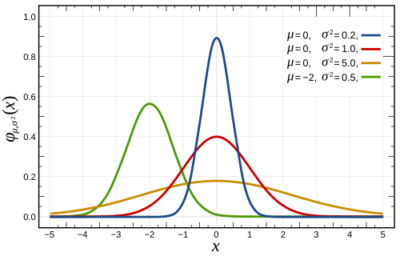
normal distribution
Normal distribution is a probability distribution.
All 1 facts, and where they come from
Facts
1 facts · 0 confirmed by two sources · 0 cited · 1 from one source
Where this comes from
Papalocal keeps its own record. It started from these sources; what each one said is kept here as it was copied, so a change on their side never changes this page by itself. Tap one to read its version.
What Wikidata says · copied November 17, 2026 · revision 2550409440
- Described as
- probability distribution
- Other names
- Gaussian distribution, bell curve, Normal distribution
- Named after
- Carl Friedrich Gauss
- Wikipedias with a page
- 76
Wikidata item Q133871 (wikidata.org/wiki/Q133871), public domain (CC0). Copied 2026-11-17.
What Wikipedia says · copied November 17, 2026 · revision 1382495450
In probability theory and statistics, a normal distribution or Gaussian distribution is a type of continuous probability distribution for a real-valued random variable. The general form of its probability density function is
f(x)=12πσ2exp(−(x−μ)22σ2).
The parameter μ is the mean or expectation of the distribution (and also its median and mode), while the parameter σ2 is the variance. The standard deviation of the distribution is the positive value σ (sigma). A random variable with a Gaussian distribution is said to be normally distributed and is called a normal deviate.
Normal distributions are important in statistics and are often used in the natural and social sciences to represent real-valued random variables whose distributions are not known. Their importance is partly due to the central limit theorem. It states that the average of many statistically independent samples (observations) of a random variable with finite mean and variance is itself a random variable—whose distribution converges to a normal distribution as the number of samples increases. Therefore, physical quantities that are expected to be the sum of many independent processes, such as measurement errors, often have distributions that are nearly normal.
Moreover, Gaussian distributions have some unique properties that are valuable in analytic studies. For instance, any linear combination of a fixed collection of independent normal deviates is a normal deviate. Many results and methods, such as propagation of uncertainty and least squares parameter fitting, can be derived analytically in explicit form when the relevant variables are normally distributed.
However, normal distributions are frequently misused in contexts where the assumption that the data are normally distributed is not met and the normal distribution is a poor model.
A normal distribution is sometimes informally called a bell curve. However, many other distributions are bell-shaped (such as the Cauchy, Student's t, and logistic distributions). (For other names, see Naming.)
The univariate probability distribution is generalized for vectors in the multivariate normal distribution and for matrices in the matrix normal distribution.
From the Wikipedia article “Normal distribution” (en.wikipedia.org/wiki/Normal_distribution), by its contributors, under CC BY-SA 4.0 (creativecommons.org/licenses/by-sa/4.0/). Copied 2026-11-17; not changed.
Confirmed Two sources agree. Cited One source, and it names where it got it. One source One source, without a reference of its own. Sources disagree The sources disagree. We show the best-supported value and keep theirs below.
Picture: Inductiveload, via Wikimedia Commons · Public domain